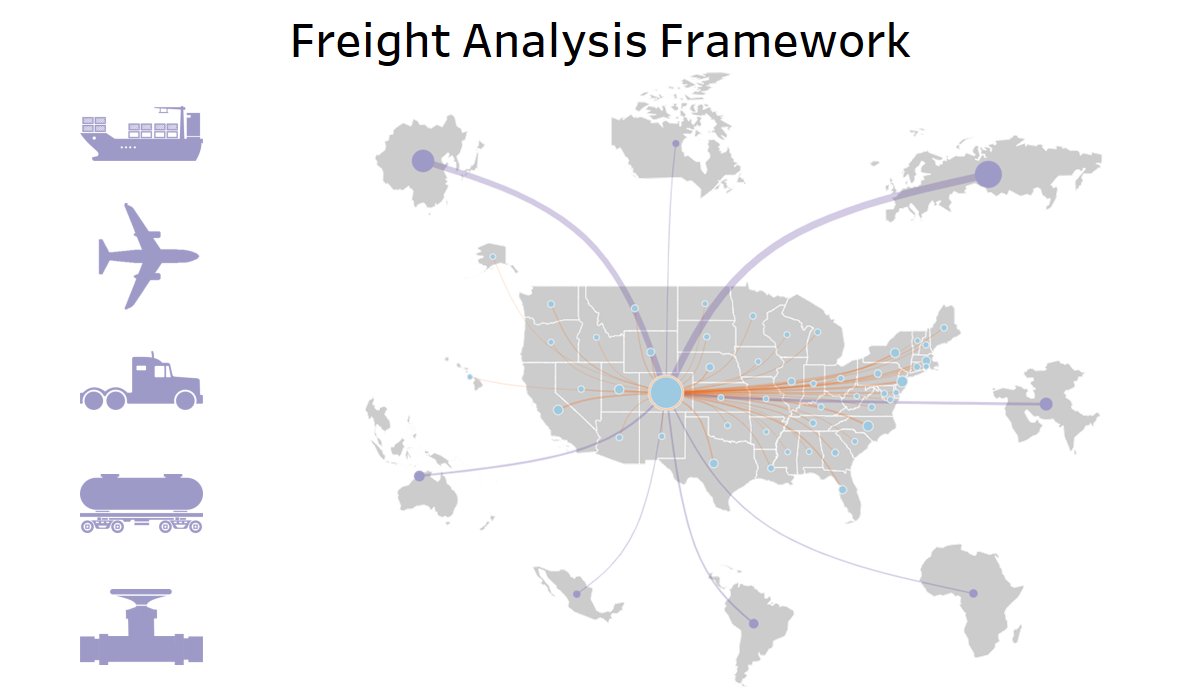


Freight Analysis Framework
Query and Visualize Commodity Flow Estimates
Use the FAF5 Data Tabulation Tool to create custom tables and visualizations based on the latest version of FAF5, or an alternate tool by our partners at FHWA based on FAF5.5.1.
About the Freight Analysis Framework
The Freight Analysis Framework (FAF) database provides estimates of US freight flows. The FAF provides data for states and metropolitan areas. Flows include all modes of transportation and 42 commodity types. The Bureau of Transportation Statistics (BTS) produces the FAF with support from the Federal Highway Administration (FHWA). BTS builds FAF with data from many sources. Inputs include the Commodity Flow Survey (CFS), foreign trade data, and data from agriculture, extraction, utility, construction, service, and other sectors.
FAF5 includes three types of freight flows: weight, value and activity. The FAF provides weight in thousands of tons, value in millions of 2017 constant dollars, and activity in millions of ton-miles. Users can download .csv and Microsoft Access files below.
Update: FAF 5.7.1 is now available. FAF 5.7.1 extends the improvements from FAF 5.7, which were applied to the 2024 estimates, to the estimates for 2018 through 2023. This involves improved estimates of the U.S. point of entry or exit for foreign trade flows that use ground modes to cross the Canada and Mexico borders and for waterborne foreign trade flows. FAF 5.7.1 applies two additional improvements to all estimates between 2018 and 2024. First, FAF 5.7.1 uses the U.S. Army Corps of Engineers waterborne commerce statistics for 2023 (previously, the latest available year was 2022). Second, previous versions of the annual estimates assigned a small amount of foreign gravel flows (SCTG 12) to pipeline mode based on how it was originally coded in administrative records. FAF 5.7.1 now codes the mode for these flows as Other/Unknown or Truck.
The latest version of FAF (FAF5.7.1) provides estimates of weight, value, and activity by origin and destination regions, commodity type, and mode for:
- Base year (2017)
- Annual estimates (2018–2023)
- Preliminary annual estimates (2024)
- Forecast year estimates (2030–2050)
- State-level historical trend estimates (1997–2012)
- Experimental county-to-county estimates (2022) (this product is based on FAF5.6.1)
The new FAF6 benchmark will be available in mid-2026.
- Regional databases of tonnage and value by origin-destination pair, commodity type, and mode.
- FAF5.7.1 Regional database for 2017-2024 with forecasts up to 2050 (mid-range estimates only): FAF5.7.1_access.zip (MS Access) | FAF5.7.1.zip (.csv)
- FAF5.7.1 Regional database for 2017-2024 with forecasts up to 2050 (including high and low estimates): FAF5.7.1_HiLoForecasts_access.zip (MS Access) | FAF5.7.1_HiLoForecasts.zip (.csv)
- FAF5.7.1 Regional database for 2018-2024: FAF5.7.1_2018-2024_access.zip (MS Access) | FAF5.7.1_2018-2024.zip (.csv)
- State databases of tonnage and value by origin-destination pair, commodity type, and mode.
- FAF5.7.1 State Database for 2017 and forecasts up to 2050 (mid-range estimates only):
FAF5.7.1_State_access.zip (MS Access) | FAF5.7.1_State.zip (.csv) - FAF5.7.1 State Database for 2017 and forecasts up to 2050 (including high and low estimates): FAF5.7.1_State_HiLoForecasts_access.zip (MS Access) | FAF5.7.1_State_HiLoForecasts.zip (.csv)
- FAF5.7.1 State Database for 2018-2024:
FAF5.7.1_State_2018-2024_access.zip (MS Access) | FAF5.7.1_State_2018-2024.zip (.csv) - FAF5.7.1 Reprocessed State Level Data for 1997-2012: FAF5.7.1_Reprocessed_1997-2012_State_access.zip (MS Access) | FAF5.7.1_Reprocessed_1997-2012_State.zip (.csv)
- FAF5.7.1 State Database for 2017 and forecasts up to 2050 (mid-range estimates only):
- FAF5 Truck Network Database and Flow Assignment (2017, 2022, and 2050)
Overview
The Freight Analysis Framework (FAF) database provides estimates of the weight and value of shipments throughout the United States for all commodity types and forms of transportation using a geographic system of 132 FAF zones. The Bureau of Transportation Statistics (BTS) developed an experimental county-to-county commodity flow product to provide the user community with more geographically granular commodity flow data to support planning, policymaking, and operational decisions at the state and local levels. Using the links below, users can download state-specific files or the entire set of disaggregation factors to create customized queries. Users can access the User Guide and technical documentation that accompany this release. This experimental product provides flows for five commodity groups and five mode categories (see documentation for more details). BTS welcomes users to email FAF@dot.gov with feedback on this experimental product.
Note about Versions
The experimental county-level estimates are based on Freight Analysis Framework version 5.6.1 (FAF5.6.1). The annual estimates have been updated since the county-level release. The FAF Versions page describes differences between FAF5.6.1 and more recent estimates.
How to Download Files
Download the zipfile experimental factors for all U.S. counties.
Click on the following links to download files for each state. The state FIPS code is also shown next to the state. Each zip file contains four tables with 1) county-level OD flows for the state of interest and every adjacent state, 2) county-to-FAF OD flows from the multi-state area to all other FAF zones, 3) FAF-to-county OD flows from all other FAF zones to the multi-state area, and 4) FAF-to-FAF OD flows from all other FAF zones to all other FAF zones. The files use county-level geography for the state of interest and states adjacent to this state. FAF zones represent flows outside of this area.
01 - Alabama
02 - Alaska
04 - Arizona
05 - Arkansas
06 - California
08 - Colorado
09 - Connecticut
10 - Delaware
11 - Washington DC
12 - Florida
13 - Georgia
15 - Hawaii
16 - Idaho
17 - Illinois
18 - Indiana
19 - Iowa
20 - Kansas
21 - Kentucky
22 - Louisiana
23 - Maine
24 - Maryland
25 - Massachusetts
26 - Michigan
27 - Minnesota
28 - Mississippi
29 - Missouri
30 - Montana
31 - Nebraska
32 - Nevada
33 - New Hampshire
34 - New Jersey
35 - New Mexico
36 - New York
37 - North Carolina
38 - North Dakota
39 - Ohio
40 - Oklahoma
41 - Oregon
42 - Pennsylvania
44 - Rhode Island
45 - South Carolina
46 - South Dakota
47 - Tennessee
48 - Texas
49 - Utah
50 - Vermont
51 - Virginia
53 - Washington
54 - West Virginia
55 - Wisconsin
56 - Wyoming
- FAF5 User Guide
- FAF5 Data Tabulation Tool: Getting Started Guide
- FAF5 Base Year Data Development: Methodology Report
- FAF5 Annual Estimates Development: Technical Report
- Webinar presentation and video (June 25, 2024)
- FAF5 citation for 2017-2050 data:
- U.S. Department of Transportation, Bureau of Transportation Statistics (BTS), Federal Highway Administration (FHWA). (2017) Freight Analysis Framework, FAF5 [datasets]. https://doi.org/10.21949/1529116
- FAF5 citation for historical reprocessed 1997-2012 data:
- U.S. Department of Transportation, Bureau of Transportation Statistics (BTS), Federal Highway Administration (FHWA). (2017) Freight Analysis Framework, FAF5 [datasets]. https://doi.org/10.21949/1529108
- FAF4 citation:
- U.S. Department of Transportation, Bureau of Transportation Statistics (BTS), Federal Highway Administration (FHWA). (2012) Freight Analysis Framework, FAF4 [datasets].
- FAF1 to FAF3 citation:
- U.S. Department of Transportation, Federal Highway Administration (FHWA). (1997-2007) Freight Analysis Framework, FAF-1-3 [datasets].
Previous Versions
Read about previous FAF5 versions and FAF's version numbering and view FAF4 data and documentation.