


The November 2025 Freight Transportation Services Index (TSI) Rose 1.2% from October 2025 and Rose 1.2% from November 2024
BTS 26-08
This release is published on a fixed schedule as required by the Office of Management and Budget, and statistics in this release may be revised when inputs to the statistics are corrected or updated. Data on the program page of this website are the most up-to-date and complete.
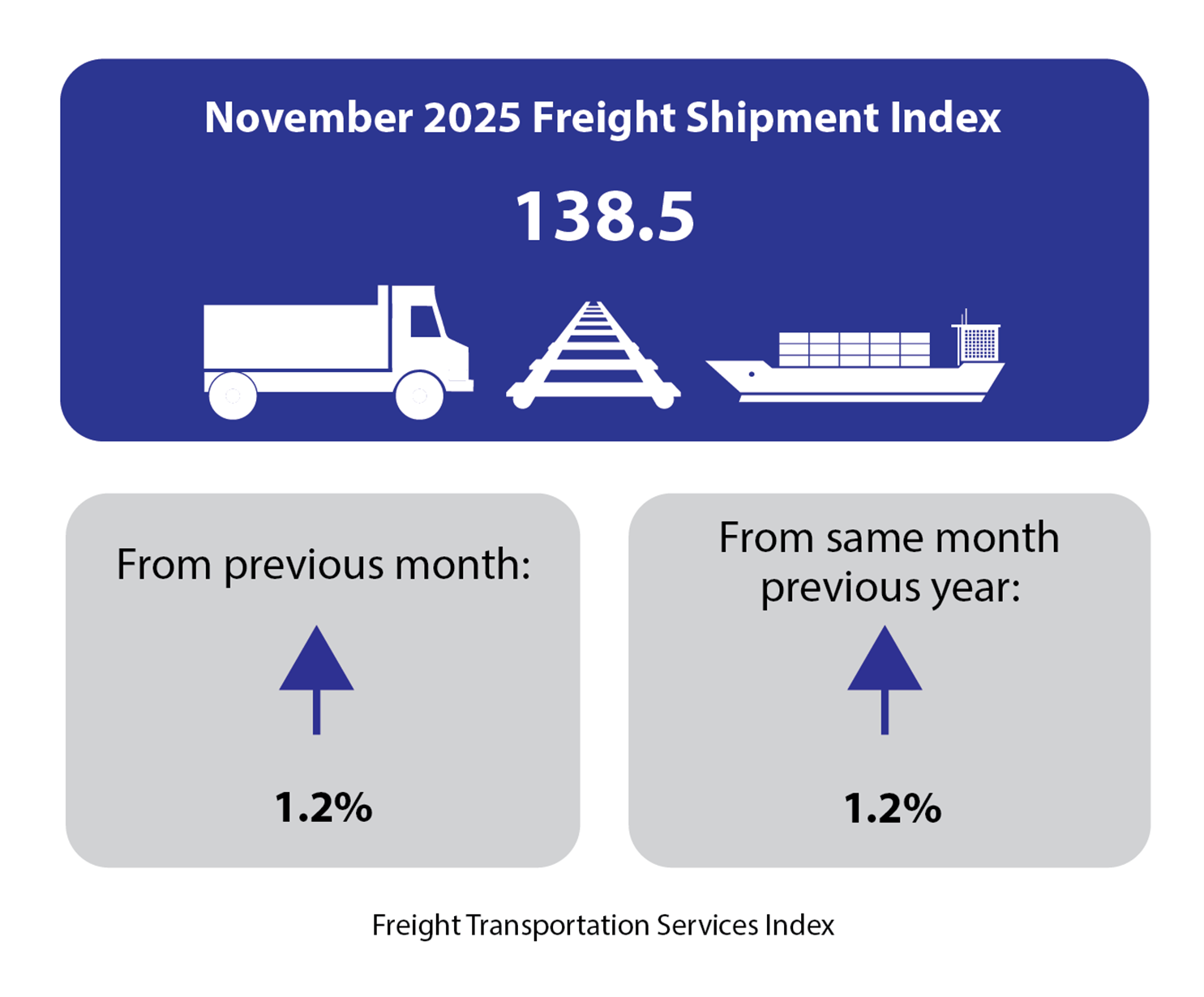
The Freight Transportation Services Index (TSI), rose 1.2% in November from October, rising for the month after two months of decline, according to the U.S. Department of Transportation Bureau of Transportation Statistics (BTS). From November 2024 to November 2025 the index rose 1.2%. The freight TSI measures the amount of freight carried by the for-hire transportation industry.
In addition to the regular monthly release covering all the modes, BTS is now publishing a new Truck-Rail Freight Services Index focused exclusively on truck and rail shipments, available about two weeks ahead of the full release.
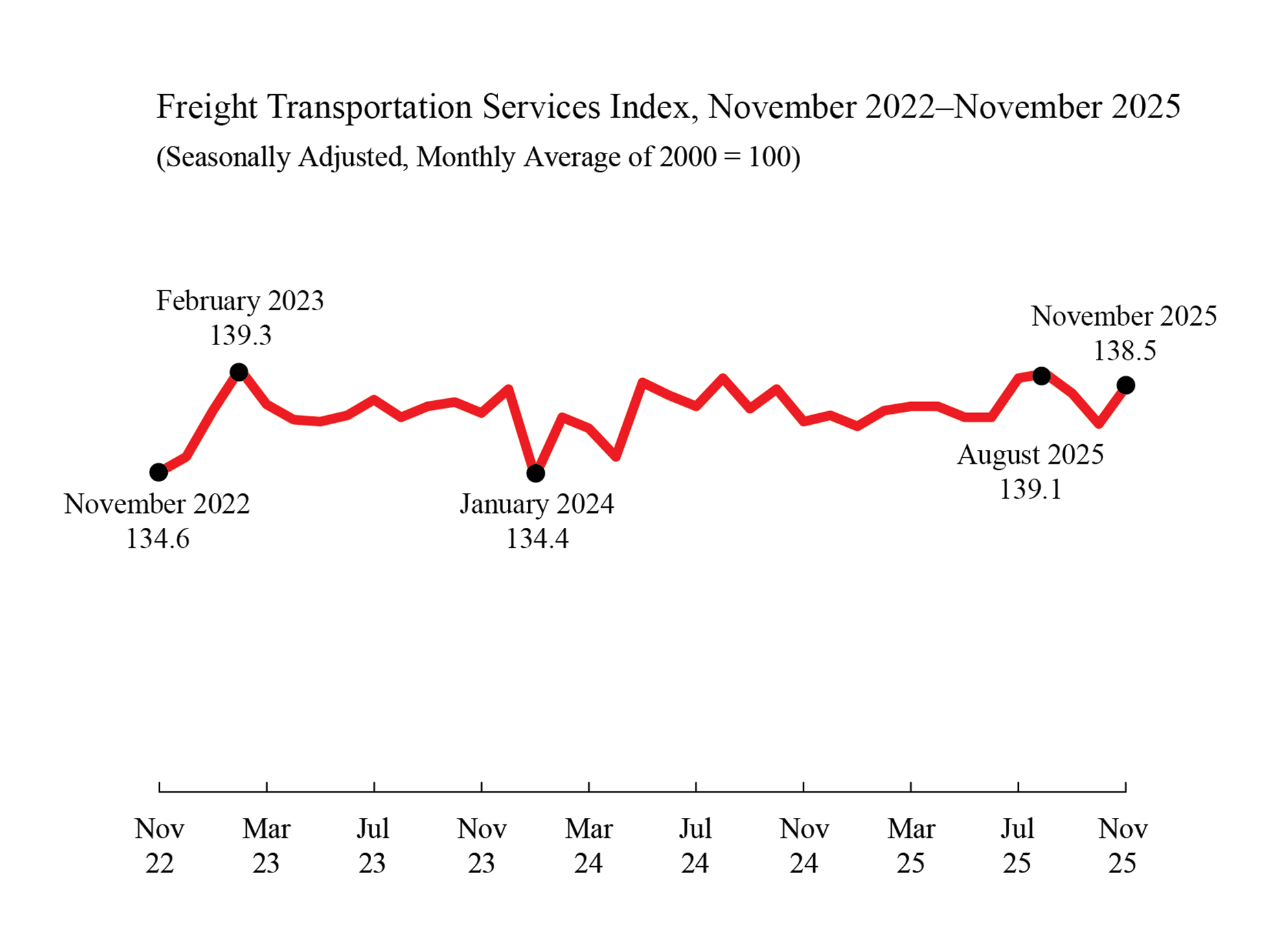
Freight Transportation Services Index, November 2022 - November 2025
| Month | Freight TSI |
|---|---|
| Oct-22 | 137.0 |
| Nov-22 | 134.6 |
| Dec-22 | 135.4 |
| Jan-23 | 137.5 |
| Feb-23 | 139.1 |
| Mar-23 | 137.7 |
| Apr-23 | 137.1 |
| May-23 | 136.9 |
| June-23 | 137.2 |
| Jul-23 | 137.9 |
| Aug-23 | 137.1 |
| Sep-23 | 137.7 |
| Oct-23 | 137.8 |
| Nov-23 | 137.3 |
| Dec-23 | 138.5 |
| Jan-24 | 134.5 |
| Feb-24 | 136.9 |
| Mar-24 | 136.6 |
| Apr-24 | 135.3 |
| May-24 | 138.7 |
| Jun-24 | 138.1 |
| Jul-24 | 137.7 |
| Aug-24 | 138.9 |
| Sept-24 | 137.5 |
| Oct-24 | 138.4 |
| Nov-24 | 136.9 |
| Dec-24 | 137.3 |
| Jan-25 | 136.8 |
| Feb-25 | 137.2 |
| Mar-25 | 137.7 |
| Apr-25 | 137.6 |
| May-25 | 137.1 |
| Jun-25 | 137.1 |
| Jul-25 | 138.9 |
| Aug-25 | 139.1 |
| Sep-25 | 138.3 |
| Oct-25 | 136.7 |
| Nov-25 | 138.5 |
The Passenger TSI rose 0.3% in November from October, rising for the second consecutive month. From November 2024 to November 2025 the index rose 1.4%. The Passenger TSI measures passenger transportation volumes on local transit, intercity rail, and air transportation. The Combined Freight and Passenger Index rose by 0.9% in November from October and rose by 1.2% from November 2024 to November 2025.
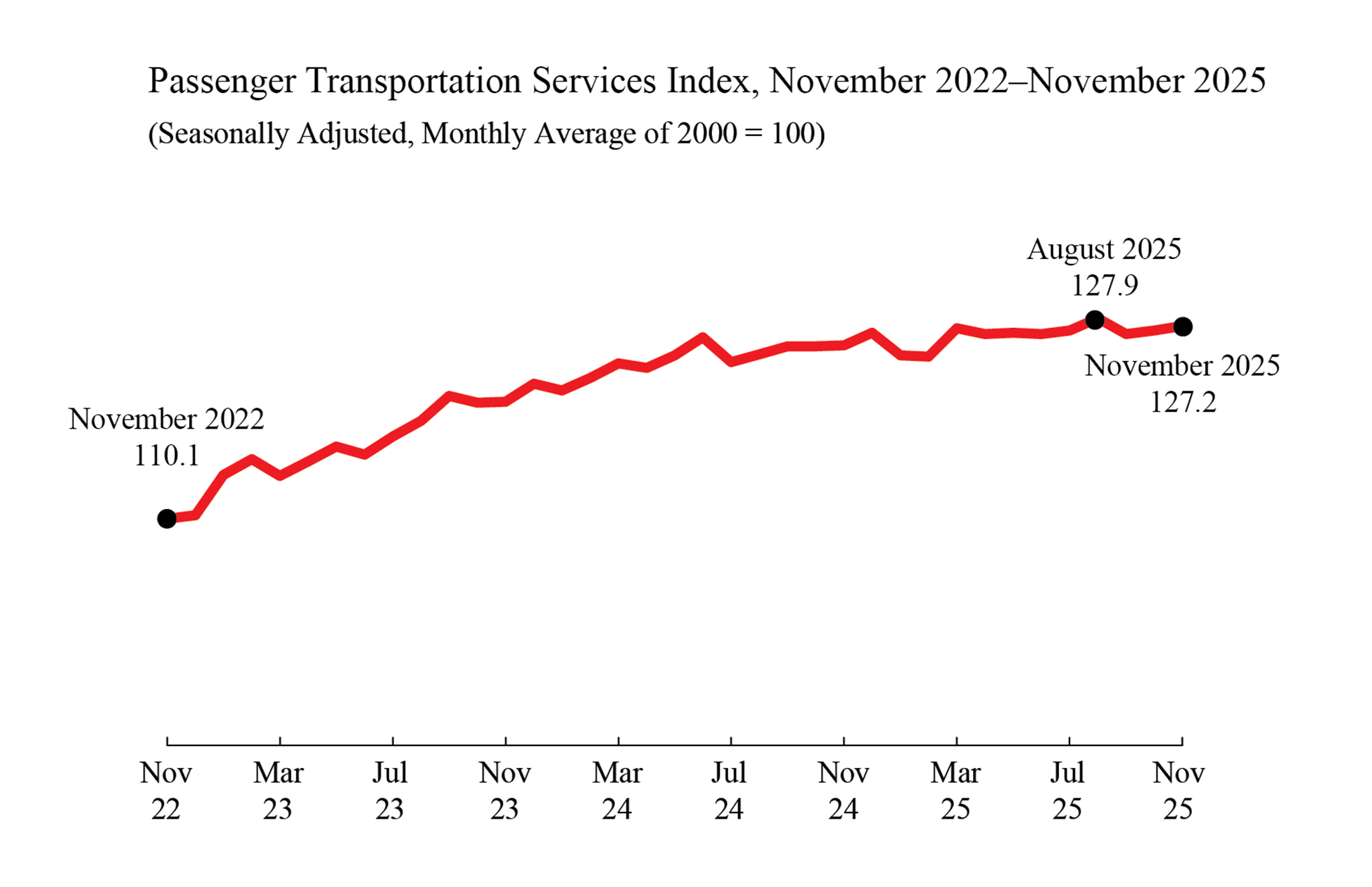
Analysis: The Freight TSI increased in November 2025 due to increases in rail carloads, pipeline, and trucking volumes while air freight, rail intermodal, and water volumes decreased.
The Passenger TSI increased in November due to increases in air passenger, rail passenger, and transit volumes. Despite the increase, the November 2025 Passenger TSI remained below the 2025 high and 7.2% below the all-time high in January 2020.
The table below shows Freight TSI and its changes in the context of other important monthly economic indicators. The table shows seasonally adjusted indicators unless noted. Several of the other economic indicators were not available due to the lapse in Federal appropriations.
The Freight TSI in Comparison to Other Economic Indicators
|
Economic Indicator |
September |
October |
November |
|
Freight Transportation Services Index |
138.2 |
136.8 |
138.5 |
|
Percent Change |
-0.6 |
-1.0 |
1.2 |
|
Federal Reserve Board (FRB) Industrial Production Index |
101.7 |
101.6 |
101.8 |
|
Percent Change |
0.1 |
-0.1 |
0.2 |
|
FRB Manufacturing (percent change) |
0.0 |
-0.40 |
0.0 |
|
FRB Mining (percent change) |
-0.7 |
-0.8 |
1.7 |
|
FRB Utilities (percent change) |
1.1 |
2.6 |
-0.4 |
|
Retail Sales: Retail Trade (millions of nominal dollars) |
632,664.0 |
NA |
NA |
|
Percent Change |
0.1 |
NA |
NA |
|
Personal Income (billions of chained 2017 dollars) |
20,603.3 |
NA |
NA |
|
Percent Change |
0.1 |
NA |
NA |
|
Institute for Supply Management Manufacturing Index |
49.1 |
48.7 |
48.2 |
|
(50+ = expansion) |
|||
|
0.4 |
-0.4 |
-0.5 |
BTS estimates pipeline petroleum, air freight, and air passenger one month ahead of reported data (i.e., the pipeline and air data are available through October, BTS estimates the November pipeline petroleum, air freight, and air passenger in the November index).
Revisions: Monthly data has changed from previous releases due to the use of concurrent seasonal analysis, which results in seasonal analysis factors changing as each month’s data are added. BTS revised the October freight index to 136.8 from 136.7 in last month's release and the October passenger index to 126.8 from 127.3.
BTS has scheduled the release of the December 2025 index for February 11, 2026.
See Seasonally-Adjusted Transportation Data for historical data from 2000 to the present and numbers for individual modes. The TSI and modal data also can be found on the FRED database. See Transportation as an Economic Indicator: Transportation Services Index for charts and discussion about the TSI and its relationship to the economy. The BTS report, Transportation Services Index and the Economy, provides a detailed explanation about the relationship between the TSI and economic cycles.
Looking for tables? BTS moved all tables online to streamline the monthly release.
Brief Explanation of the TSI
The TSI measures the month-to-month changes in the output of services provided by the for-hire transportation industries. The freight index measure changes in freight shipments while the passenger index measures changes in passenger travel.
The TSI tells us how the output of transportation services increased or decreased from month to month. The index can be examined together with other economic indicators to produce a better understanding of the current and future course of the economy. The movement of the index over time can be compared with other economic measures to understand the relationship of changes in transportation output to changes in Gross Domestic Product.
The freight transportation index consists of:
- For-hire trucking,
- Railroad freight services (including rail based intermodal shipments such as containers on flat cars),
- Inland waterways transportation,
- Pipeline transportation (including principally petroleum and petroleum products and natural gas), and
- Air freight.
The index does not include international or coastal waterborne movements, private trucking, courier services, or the US Postal Service.
The passenger transportation index consists of:
- Local transit,
- Intercity passenger rail, and
- Passenger air transportation.
The index does not include intercity bus, sightseeing services, ferry services, taxi service, private automobile usage, or bicycling and other non-motorized transportation.
The TSI includes only domestic "for-hire" freight and passenger transportation. For-hire transportation consists of freight or passenger transport services provided by a firm to external customers for a fee. The TSI does not include taxi services, paid ride services in personal motor vehicles (e.g., Uber, Lyft, etc.), intercity bus services, in-house transportation (vehicles owned and operated by private firms for their own use), or noncommercial passenger travel (e.g., trips in the household car).
To receive updates from BTS directly to your email, please consider subscribing to our GovDelivery service.