


U.S. Cargo and Passenger Airlines Lost 15,011 Jobs in January 2026
BTS 26-27
This release is published on a fixed schedule as required by the Office of Management and Budget, and statistics in this release may be revised when inputs to the statistics are corrected or updated. Data on the program page of this website are the most up-to-date and complete.
Note: In June 2024, FedEx Ground and FedEx Services merged with FedEx Express to form Federal Express Corporation. Consequently, carrier FX experienced a significant increase in employee count, thereby increasing the total number of employees within the industry.
May 2024 Federal Express numbers are 233,739, while Federal Express Corporation June 2024 numbers are 432,127.
U.S. Airlines: Total Number of Employees (both Full-Time and Part-Time)
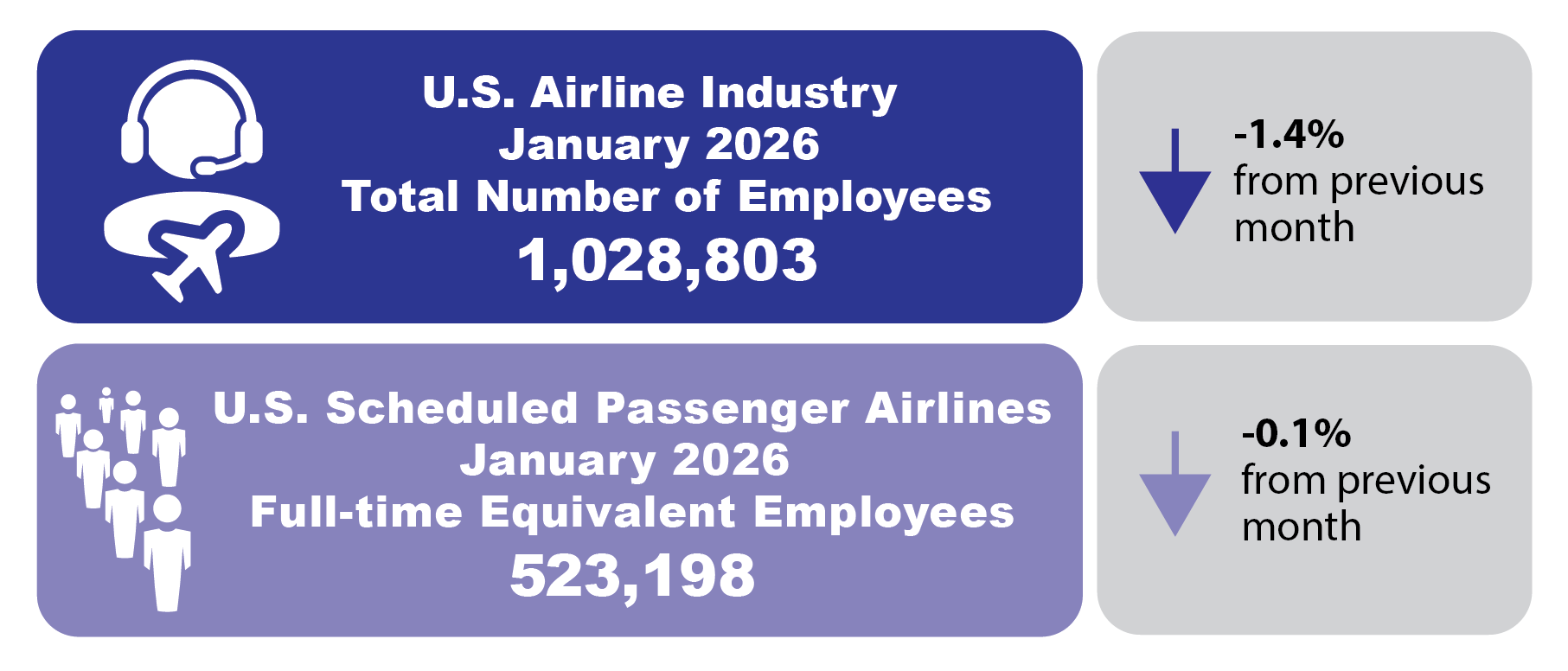
U.S. airline industry (passenger and cargo airlines combined) employment decreased to 1,028,803 workers in January 2026, 15,011 (1.44%) fewer workers than in December 2025 (1,043,814).
U.S. scheduled-service passenger airlines employed 552,682 workers in January 2026, or 54% of the industry-wide total. Passenger airlines lost 845 employees in January 2026. Southwest Airlines led scheduled passenger carriers, adding 296 employees; United Air Lines added 272, and Frontier Airlines added 258.
U.S. cargo airlines employed 471,876 workers in January 2026, or 46% of the industry-wide total. Cargo carriers lost 14,192 employees in January 2026. FedEx, the leading air cargo employer, decreased employment by 14,486 jobs.
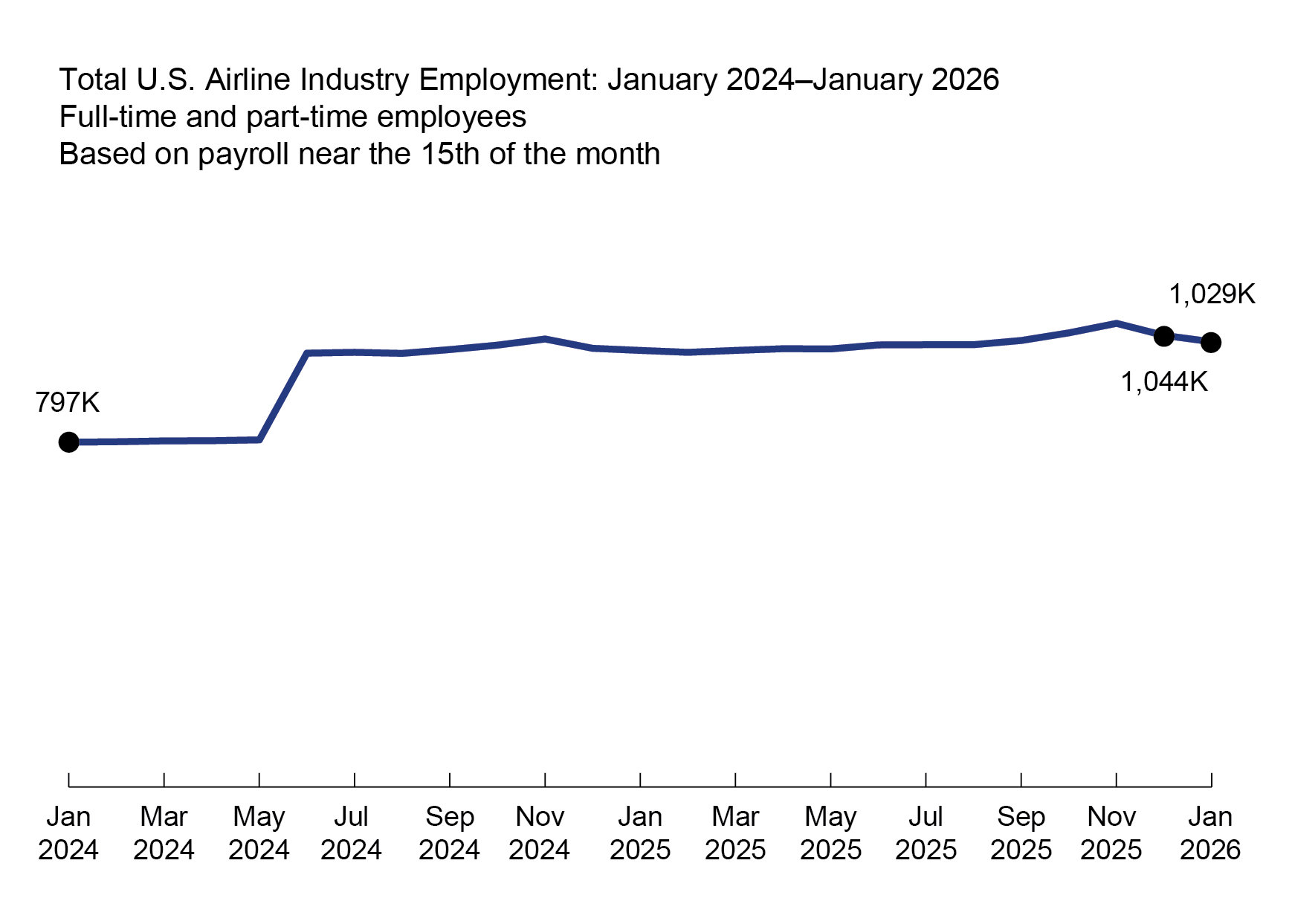
See FedEx note for discontinuity in May 2024.
Scheduled passenger airlines lost 691 full-time equivalents in January 2026
U.S. Airline Full-Time Equivalents (FTEs)
BTS calculates FTEs by dividing the number of part-time employees by 2 and adding that figure to the number of full-time employees. The January 2026 industry-wide numbers include 753,470 full-time and 275,333 part-time workers for a total of 891,137 FTEs, a decrease from December (900,508) of 9,371 FTEs (1.04%).
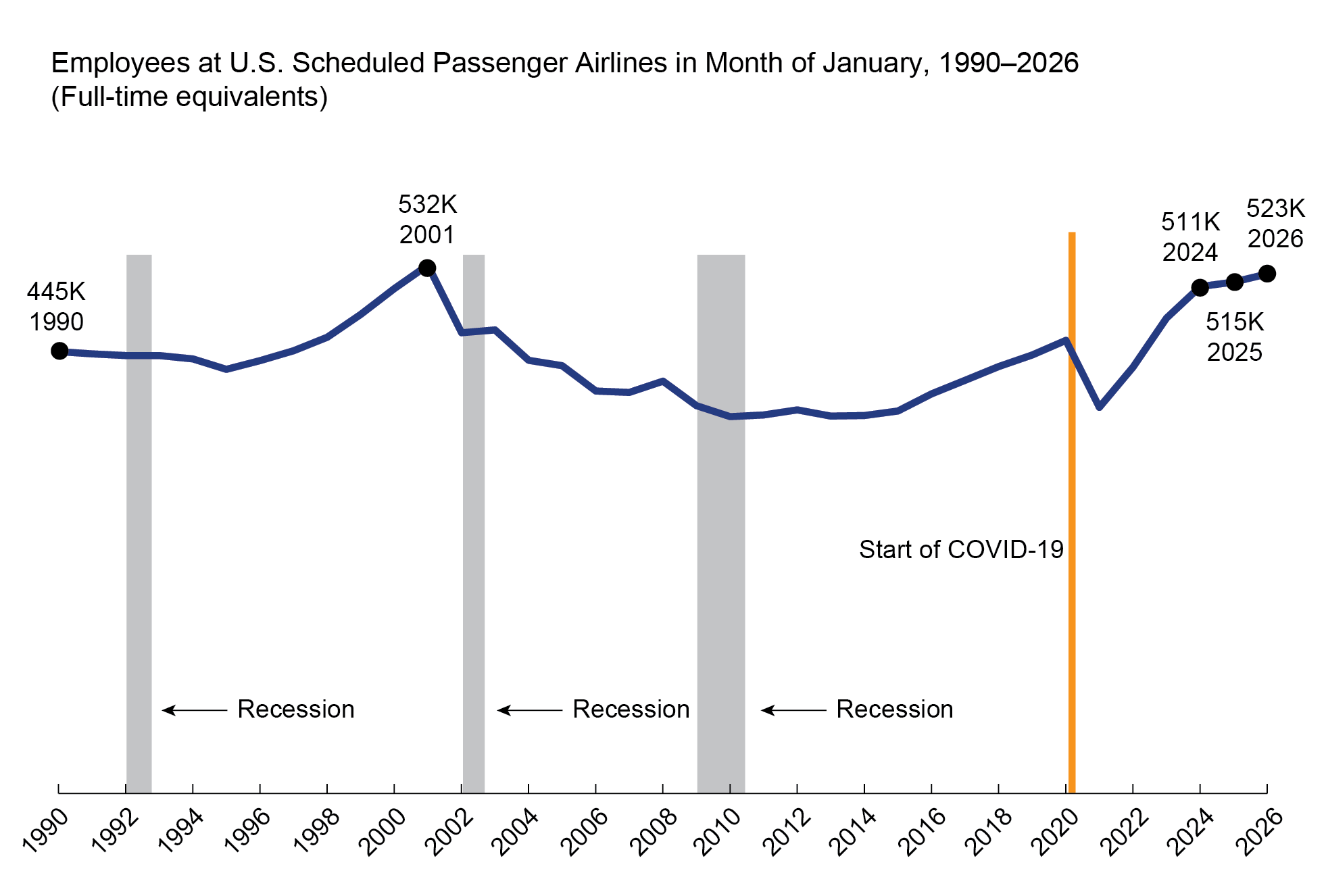
The 25 U.S. scheduled passenger airlines reporting data for January 2026 employed 523,198 FTEs, 691 FTEs (0.13%) less than in December 2025 (523,888). Data by passenger carrier category can be found in the accompanying tables.
U.S. cargo airlines employed 363,777 FTEs in January 2026, down 8,706 FTEs (2.34%) from December 2025 (372,483).
Reporting Notes
Data is compiled from monthly reports filed with BTS by commercial air carriers as of March 12, 2026. Additional airline employment data and previous releases can be found on the BTS website. The month-to-month numbers are not seasonally adjusted.
Passenger, cargo, and charter airlines that operate at least one aircraft that has more than 60 seats or the capacity to carry a payload of passengers, cargo, and fuel weighing more than 18,000 pounds must report monthly employment statistics. Regulations require U.S. airlines to report employment numbers for employees who worked or received pay for any part of the pay period(s) ending nearest the 15th day of the month.
See the tables that accompany this release on the BTS website for detailed data (Tables 1-15) and industry summary monthly data since 1990. Additional individual airline numbers are available on the BTS airline employment web page. The web page provides full-time and part-time employment numbers by carrier by month from 1990 through January 2026.
Missing Carrier: Ameristar Air Cargo (AMQ).
The next update for U.S. airline employment is scheduled for Thursday, April 16, 2026.
To receive updates from BTS directly to your email, please consider subscribing to our GovDelivery service.