

September 2016 Passenger Airline Employment Data
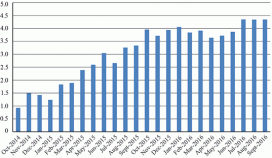
U.S. scheduled passenger airlines employed 4.3 percent more workers in September 2016 than in September 2015, the U.S. Department of Transportation’s Bureau of Transportation Statistics (BTS) reported today. September was the highest monthly total (414,591) since July 2005 (414.923) and was the 35th consecutive month that U.S. scheduled passenger airline full-time equivalent (FTE) employment exceeded the same month of the previous year (Tables 1, 2, 3).
U.S. Scheduled Passenger Airline Employment Percent Change from Previous Year (Last 24 months)
| U.S. Scheduled Passenger Airline Employment Percent Change from Previous Year (Last 24 months) | |
|---|---|
| 10/2014 | 0.9 |
| 11/2014 | 1.5 |
| 12/2014 | 1.4 |
| 01/2015 | 1.2 |
| 02/2015 | 1.8 |
| 03/2015 | 1.9 |
| 04/2015 | 2.4 |
| 05/2015 | 2.6 |
| 06/2015 | 3.0 |
| 07/2015 | 2.7 |
| 08/2015 | 3.3 |
| 09/2015 | 3.3 |
| 10/2015 | 4.0 |
| 11/2015 | 3.7 |
| 12/2015 | 3.9 |
| 01/2016 | 4.1 |
| 02/2016 | 3.8 |
| 03/2016 | 3.9 |
| 04/2016 | 3.6 |
| 05/2016 | 3.7 |
| 06/2016 | 3.9 |
| 07/2016 | 4.3 |
| 08/2016 | 4.3 |
| 09/2016 | 4.3 |
Month-to-month, the number of FTEs rose 0.1 percent from August to September (Table 1A). Scheduled passenger airline categories include network, low-cost, regional and other airlines. Historical employment data can be found on the BTS web site.
The four network airlines that collectively employ two-thirds of the scheduled passenger airline FTEs reported 2.6 percent more FTEs in September 2016 than in September 2015 (Tables 7, 8, 9). United Airlines, Alaska Airlines, American Airlines and Delta Air Lines increased FTEs from September 2015 (Table 9). Month-to-month, the number of network airline FTEs was virtually unchanged from August to September (Table 1A).
The network airlines employed 5.5 percent more FTEs in September 2016 than in September 2012 (Tables 8, 9). Network airlines operate a significant portion of their flights using at least one hub where connections are made for flights to down-line destinations or spoke cities.
The six low-cost carriers reported 10.7 percent more FTEs in September 2016 than in September 2015 (Tables 10, 11, 12). Allegiant Airlines, Spirit Airlines, Frontier Airlines, JetBlue Airways, Virgin America and Southwest Airlines increased FTEs from September 2015 (Table 12). Month-to-month, the number of low-cost airline FTEs rose 0.6 percent from August to September (Table 1A). The six low-cost airlines employed 21.2 percent more FTEs in September 2016 than in September 2012 (Tables 11, 12). Low-cost airlines operate under a low-cost business model, with infrastructure and aircraft operating costs below the overall industry average.
The 12 regional carriers reported 2.9 percent more FTEs in September 2016 than in September 2015 (Tables 13, 14, 15). Nine regional airlines – Republic Airlines, Compass Airlines, PSA Airlines, Mesa Airlines, Endeavor Air, GoJet Airlines, Envoy Air, SkyWest Airlines, and Horizon Air – increased FTEs from September 2015. The others reported decreases (Table 15). Month-to-month, the number of regional airline FTEs fell 0.6 percent from August to September (Table 1A). The 12 regional carriers reporting in September 2016 employed 0.8 percent fewer FTEs in September 2016 than the 15 carriers reporting in September 2012 (Tables 14, 15). Regional carriers typically provide service from small cities, using primarily regional jets to support the network carriers’ hub and spoke systems.
Carrier Groups: The four network airlines employed 65.6 percent of the 414,591 FTEs employed by all scheduled passenger airlines in September, the six low-cost carriers employed 20.3 percent and the 12 regional carriers employed 12.2 percent (Table 4). In comparison, in September 2006, the network airlines employed 65.5 percent of the FTEs, the six low-cost carriers employed 17.4 percent and the 12 regional carriers employed 13.8 percent (Table 5).
Top Employers by Group: American employed the most FTEs (99,037) in September among the network airlines, Southwest employed the most FTEs (53,072) among low-cost airlines, and Envoy employed the most FTEs (10,889) among regional airlines (Table 6). The three airlines with the most FTEs in September – American, Delta and United – employed 62.9 percent of the month’s total passenger airline FTEs (Tables 3, 6).
Reporting Notes
Airlines that operate at least one aircraft that has more than 60 seats or the capacity to carry a payload of passengers, cargo and fuel weighing more than 18,000 pounds must report monthly employment statistics.
The “Other Carrier” category generally reflects those airlines that operate within specific niche markets such as the Hawaiian Islands served by Hawaiian Airlines and Island Air Hawaii.
Data are compiled from monthly reports filed with BTS by commercial air carriers as of Nov. 10. Additional airline employment data and previous press releases can be found on the BTS website. BTS has scheduled release of October passenger airline employment data for Dec. 16.
Table 1: Yearly Change in Scheduled Passenger Airline Full-time Equivalent Employees* by Airline Group
| Network Airlines | Low-Cost Airlines | Regional Airlines | All Passenger Airlines** | |
|---|---|---|---|---|
| Sep 2014-Sep 2015 | 3.6 | 6.6 | -2.7 | 3.3 |
| Oct 2014-Oct 2015 | 3.6 | 6.9 | 1.4 | 4.0 |
| Nov 2014-Nov 2015 | 3.7 | 6.5 | -0.2 | 3.7 |
| Dec 2014-Dec 2015 | 3.5 | 7.8 | 0.9 | 3.9 |
| Jan 2015-Jan 2016 | 3.3 | 7.9 | 2.0 | 4.1 |
| Feb 2015-Feb 2016 | 3.2 | 8.5 | 0.2 | 3.8 |
| Mar 2015-Mar 2016 | 2.9 | 9.6 | 0.4 | 3.9 |
| Apr 2015-Apr 2016 | 2.4 | 10.2 | 0.1 | 3.6 |
| May 2015-May 2016 | 2.3 | 10.7 | 0.2 | 3.7 |
| June 2015-Jun 2016 | 2.3 | 11.0 | 0.9 | 3.9 |
| July 2015-July 2016 | 2.4 | 11.3 | 3.3 | 4.3 |
| Aug 2015-Aug 2016 | 2.5 | 11.0 | 3.3 | 4.3 |
| Sep 2015-Sep 2016 | 2.6 | 10.7 | 2.9 | 4.3 |
Percent changes based on numbers prior to rounding.
See Table 2 for all passenger airlines, Table 7 for Network, Table 10 for Low-Cost and Table 13 for Regional.
* Full-time Equivalent Employee (FTE) calculations count two part-time employees as one full-time employee.
** Includes network, low-cost, regional and other carriers. Other Carriers generally operate within specific niche markets. They are: Hawaiian Airlines, Sun Country Airlines and Island Air Hawaii.
Bureau of Transportation Statistics
Table 1A: Monthly Change in Scheduled Passenger Airline Full-time Equivalent Employees* by Airline Group
| Network Airlines | Low-Cost Airlines | Regional Airlines | All Passenger Airlines** | |
|---|---|---|---|---|
| Sep 2015-Oct 2015 | 0.1 | 1.2 | 2.5 | 0.7 |
| Oct 2015-Nov 2015 | 0.2 | 0.9 | 0.1 | 0.3 |
| Nov 2015-Dec 2015 | 0.0 | 0.3 | 0.0 | 0.0 |
| Dec 2015-Jan 2016 | 0.0 | 0.8 | 0.0 | 0.2 |
| Jan 2016-Feb 2016 | 0.3 | 1.2 | -0.1 | 0.4 |
| Feb 2016-Mar 2016 | 0.5 | 0.8 | 0.3 | 0.5 |
| Mar 2016-Apr 2016 | 0.3 | 1.2 | -0.4 | 0.4 |
| Apr 2016-May2016 | 0.5 | 1.1 | 0.4 | 0.6 |
| May 2016-Jun2016 | 0.3 | 0.9 | 0.5 | 0.5 |
| Jun 2016-July 2016 | 0.2 | 0.8 | 0.4 | 0.3 |
| July 2016-Aug 2016 | 0.1 | 0.4 | -0.1 | 0.1 |
| Aug 2016-Sep 2016 | 0.0 | 0.6 | -0.6 | 0.1 |
Percent changes based on numbers prior to rounding.
See Table 2 for all passenger airlines, Table 7 for Network, Table 10 for Low-Cost and Table 13 for Regional.
* Full-time Equivalent Employee (FTE) calculations count two part-time employees as one full-time employee.
** Includes network, low-cost, regional and other carriers. Other Carriers generally operate within specific niche markets. They are: Hawaiian Airlines, Sun Country Airlines and Island Air Hawaii.
Bureau of Transportation Statistics
Table 2: Change from Previous Year in Scheduled Passenger Airline* Full-time Equivalent Employees**
| Month | 2013 | 2014 | 2015 | 2016 |
|---|---|---|---|---|
| January | -1.6 | 0.5 | 1.2 | 4.1 |
| February | -1.7 | 0.4 | 1.8 | 3.8 |
| March | -1.9 | 0.8 | 1.9 | 3.9 |
| April | -1.8 | 1.0 | 2.4 | 3.6 |
| May | -1.8 | 1.1 | 2.6 | 3.7 |
| June | -1.7 | 0.9 | 3.0 | 3.9 |
| July | -1.8 | 1.3 | 2.7 | 4.3 |
| August | -1.6 | 1.0 | 3.3 | 4.3 |
| September | -0.9 | 1.1 | 3.3 | 4.3 |
| October | -0.3 | 0.9 | 4.0 | |
| November | 0.1 | 1.5 | 3.7 | |
| December | 0.3 | 1.4 | 3.9 | |
Percent changes based on numbers prior to rounding.
* Includes network, low-cost, regional and other carriers.
** Full-time Equivalent Employee (FTE) calculations count two part-time employees as one full-time employee.
Bureau of Transportation Statistics
Table 3: Scheduled Passenger Airline Full-time Equivalent Employees* by Month 2012-2016
| Month | 2012 | 2013 | 2014 | 2015 | 2016 | Percent Change | |
|---|---|---|---|---|---|---|---|
| 2012-2016 | 2015-2016 | ||||||
| January | 386,166 | 380,042 | 381,819 | 386,528 | 402,208 | 4.2 | 4.1 |
| February | 387,091 | 380,414 | 381,985 | 388,976 | 403,917 | 4.3 | 3.8 |
| March | 387,968 | 380,540 | 383,575 | 390,817 | 406,113 | 4.7 | 3.9 |
| April | 387,501 | 380,487 | 384,265 | 393,439 | 407,763 | 5.2 | 3.6 |
| May | 388,341 | 381,372 | 385,619 | 395,621 | 410,338 | 5.7 | 3.7 |
| June | 388,165 | 381,672 | 385,243 | 396,973 | 412,333 | 6.2 | 3.9 |
| July | 388,475 | 381,299 | 386,243 | 396,503 | 413,746 | 6.5 | 4.3 |
| August | 386,749 | 380,486 | 384,478 | 397,007 | 414,242 | 7.1 | 4.3 |
| September | 383,604 | 380,165 | 384,501 | 397,326 | 414,591 | 8.1 | 4.3 |
| October | 382,162 | 381,178 | 384,700 | 399,928 | |||
| November | 380,949 | 381,224 | 386,912 | 401,280 | |||
| December | 379,575 | 380,809 | 386,222 | 401,440 | |||
| 12-Month Average | 385,562 | 380,807 | 384,630 | 395,487 | |||
| Jan-Sep Average | 387,118 | 380,720 | 384,192 | 393,688 | 409,472 | 5.8 | 4.0 |
Percent changes based on numbers prior to rounding.
* Includes network, low-cost, regional and other carriers.
** Full-time Equivalent Employee (FTE) calculations count two part-time employees as one full-time employee.
Bureau of Transportation Statistics
Table 4: Airline Group Full-time Equivalent Employees*, September 2012-2016
| Network | Low-Cost | Regional | All Passenger Airlines** | |
|---|---|---|---|---|
| 2012 | 257,875 | 69,575 | 51,085 | 383,604 |
| 2013 | 255,194 | 69,426 | 49,546 | 380,165 |
| 2014 | 256,133 | 71,428 | 50,574 | 384,501 |
| 2015 | 265,315 | 76,176 | 49,231 | 397,326 |
| 2016 | 272,136 | 84,331 | 50,663 | 414,591 |
| Percent of Total Passenger Airline Employees in 2016 | 65.6% | 20.3% | 12.2% | 100.0% |
* Full-time Equivalent Employee (FTE) calculations count two part-time employees as one full-time employee.
** Includes network, low-cost, regional and other carriers.
Bureau of Transportation Statistics
Table 5: Carrier Group Percent of Total Scheduled Passenger Airline FTEs 2006-2016
| Year | Network | Low-Cost | Regional | Other |
|---|---|---|---|---|
| 2006 | 65.5 | 17.4 | 13.8 | 3.3 |
| 2011 | 67.6 | 17.5 | 13.7 | 1.2 |
| 2015 | 66.8 | 19.2 | 12.4 | 1.7 |
| 2016 | 65.6 | 20.3 | 12.2 | 1.8 |
* Full-time Equivalent Employee (FTE) calculations count two part-time employees as one full-time employee.
** Includes network, low-cost, regional and other carriers.
Bureau of Transportation Statistics
Table 6: Top 10 Airlines, September 2016
| Rank | Airline | Total FTE Employees | Carrier Group** | Top 10 Airlines September 2015 |
|---|---|---|---|---|
| 1 | American | 99,037 | Network | American |
| 2 | United | 81,776 | Network | Delta |
| 3 | Delta | 79,996 | Network | United |
| 4 | Southwest | 53,072 | Low-Cost | Southwest |
| 5 | JetBlue | 16,324 | Low-Cost | JetBlue |
| 6 | Alaska | 11,327 | Network | Alaska |
| 7 | Envoy | 10,889 | Regional | SkyWest |
| 8 | SkyWest | 10,581 | Regional | Envoy |
| 9 | ExpressJet | 6,567 | Regional | ExpressJet |
| 10 | Hawaiian | 5,467 | Other | Spirit |
* Full-time Equivalent Employee (FTE) calculations count two part-time employees as one full-time employee.
** See Table 9 for Network, Table 12 for Low-Cost and Table 15 for Regional.
Bureau of Transportation Statistics
Table 7: Network Airline Year-to-Year Change in Full-time Equivalent Employees* from the Previous Year
| 2013 | 2014 | 2015 | 2016 | |
|---|---|---|---|---|
| January | -2.1 | 0.4 | 0.8 | 3.3 |
| February | -1.9 | 0.1 | 1.4 | 3.2 |
| March | -2.2 | 0.6 | 1.7 | 2.9 |
| April | -2.0 | 0.4 | 2.4 | 2.4 |
| May | -2.0 | 0.5 | 2.7 | 2.3 |
| June | -1.8 | 0.3 | 3.1 | 2.3 |
| July | -1.7 | 0.4 | 3.1 | 2.4 |
| August | -1.5 | 0.1 | 3.7 | 2.5 |
| September | -1.0 | 0.4 | 3.6 | 2.6 |
| October | -0.6 | 0.3 | 3.6 | |
| November | -0.1 | 0.4 | 3.7 | |
| December | 0.4 | 0.8 | 3.5 | |
* Full-time Equivalent Employee (FTE) calculations count two part-time employees as one full-time employee.
Bureau of Transportation Statistics
Table 8: Network Airlines Full-time Equivalent Employees* by Month 2012-2016
| Month | 2012 | 2013 | 2014 | 2015 | 2016 | Percent Change | |
|---|---|---|---|---|---|---|---|
| 2012-2016 | 2015-2016 | ||||||
| January | 259,749 | 254,377 | 255,518 | 257,627 | 266,245 | 2.5 | 3.3 |
| February | 259,971 | 254,955 | 255,158 | 258,796 | 266,987 | 2.7 | 3.2 |
| March | 260,666 | 254,871 | 256,342 | 260,794 | 268,375 | 3.0 | 2.9 |
| April | 260,876 | 255,674 | 256,732 | 262,905 | 269,169 | 3.2 | 2.4 |
| May | 261,426 | 256,274 | 257,578 | 264,438 | 270,559 | 3.5 | 2.3 |
| June | 261,539 | 256,791 | 257,491 | 265,486 | 271,503 | 3.8 | 2.3 |
| July | 260,982 | 256,474 | 257,541 | 265,551 | 271,963 | 4.2 | 2.4 |
| August | 259,617 | 255,800 | 256,095 | 265,567 | 272,112 | 4.8 | 2.5 |
| September | 257,875 | 255,194 | 256,133 | 265,315 | 272,136 | 5.5 | 2.6 |
| October | 257,270 | 255,741 | 256,409 | 265,704 | |||
| November | 256,141 | 255,914 | 256,823 | 266,251 | |||
| December | 254,065 | 255,155 | 257,251 | 266,136 | |||
| 12-Month Average | 259,181 | 255,602 | 256,589 | 263,714 | |||
| Jan-Sep Average | 260,300 | 255,601 | 256,510 | 262,942 | 269,894 | 3.7 | 2.6 |
Percent changes based on numbers prior to rounding.
* Full-time Equivalent Employee (FTE) calculations count two part-time employees as one full-time employee.
Bureau of Transportation Statistics
Table 9: Network Airline Full-time Equivalent Employees*, September 2012-2016
| Rank | Airline | 2012 | 2013 | 2014 | 2015 | 2016 | Percent Change | |
|---|---|---|---|---|---|---|---|---|
| 2012-2016 | 2015-2016 | |||||||
| 1 | AA/US Combined | 93,814 | 90,187 | 91,497 | 96,700 | 99,037 | 5.6 | 2.4 |
| American** | 63,397 | 58,876 | 59,829 | 96,700 | 99,037 | N/A | 2.4 | |
| US Airways** | 30,417 | 31,311 | 31,668 | N/A | N/A | N/A | N/A | |
| 2 | United | 82,137 | 82,082 | 79,064 | 78,400 | 81,776 | -0.4 | 4.3 |
| 3 | Delta | 72,718 | 73,445 | 75,616 | 79,275 | 79,996 | 10.0 | 0.9 |
| 4 | Alaska | 9,206 | 9,480 | 9,956 | 10,940 | 11,327 | 23.0 | 3.5 |
| Total | 257,875 | 255,194 | 256,133 | 265,315 | 272,136 | 5.5 | 2.6 | |
* Full-time Equivalent Employee (FTE) calculations count two part-time employees as one full-time employee.
** American Airlines and US Airways merged and began reporting combined numbers in July 2015.
Bureau of Transportation Statistics
Table 10: Low-Cost Airline Year-to-Year Change in Full-time Equivalent Employees* from the Previous Year
| Month | 2013 | 2014 | 2015 | 2016 |
|---|---|---|---|---|
| January | 0.8 | 0.3 | 4.6 | 7.9 |
| February | 0.2 | 0.7 | 4.6 | 8.5 |
| March | 0.0 | 0.8 | 3.9 | 9.6 |
| April | -0.3 | 1.5 | 4.2 | 10.2 |
| May | -0.3 | 1.8 | 4.3 | 10.7 |
| June | -0.6 | 2.2 | 4.9 | 11.0 |
| July | -0.4 | 2.5 | 5.2 | 11.3 |
| August | -0.9 | 3.0 | 5.8 | 11.0 |
| September | -0.2 | 2.9 | 6.6 | 10.7 |
| October | -0.1 | 3.8 | 6.9 | |
| November | -0.1 | 5.2 | 6.5 | |
| December | -0.6 | 4.4 | 7.8 | |
Percent changes based on numbers prior to rounding.
* Full-time Equivalent Employee (FTE) calculations count two part-time employees as one full-time employee.
Bureau of Transportation Statistics
Table 11: Low-Cost Airline Full-time Equivalent Employees* by Month 2012-2016
| 2012 | 2013 | 2014 | 2015 | 2016 | Percent Change | ||
|---|---|---|---|---|---|---|---|
| 2012-2016 | 2015-2016 | ||||||
| January | 68,926 | 69,465 | 69,693 | 72,909 | 78,638 | 14.1 | 7.9 |
| February | 69,476 | 69,630 | 70,135 | 73,351 | 79,578 | 14.5 | 8.5 |
| March | 69,887 | 69,854 | 70,384 | 73,163 | 80,202 | 14.8 | 9.6 |
| April | 69,862 | 69,677 | 70,751 | 73,695 | 81,180 | 16.2 | 10.2 |
| May | 70,055 | 69,818 | 71,095 | 74,167 | 82,070 | 17.2 | 10.7 |
| June | 69,970 | 69,574 | 71,074 | 74,592 | 82,796 | 18.3 | 11.0 |
| July | 69,756 | 69,510 | 71,272 | 74,999 | 83,481 | 19.7 | 11.3 |
| August | 69,940 | 69,286 | 71,387 | 75,549 | 83,823 | 19.8 | 11.0 |
| September | 69,575 | 69,426 | 71,428 | 76,176 | 84,331 | 21.2 | 10.7 |
| October | 69,552 | 69,496 | 72,110 | 77,063 | |||
| November | 69,442 | 69,402 | 73,014 | 77,783 | |||
| December | 69,781 | 69,365 | 72,399 | 78,035 | |||
| 12-Month Average | 69,685 | 69,542 | 71,229 | 75,124 | |||
| Jan-Sep Average | 69,716 | 69,582 | 70,802 | 74,289 | 81,789 | 17.3 | 10.1 |
Percent changes and averages based on numbers prior to rounding.
* Full-time Equivalent Employee (FTE) calculations count two part-time employees as one full-time employee.
Bureau of Transportation Statistics
Table 12: Low-Cost Airline Full-time Equivalent Employees*, September 2012-2016
| Rank | 2012 | 2013 | 2014 | 2015 | 2016 | Percent Change | ||
|---|---|---|---|---|---|---|---|---|
| 2012-2016 | 2015-2016 | |||||||
| 1 | Southwest | 46,048 | 45,148 | 45,750 | 48,642 | 53,072 | 15.3 | 9.1 |
| 2 | JetBlue | 12,450 | 12,955 | 13,381 | 14,877 | 16,324 | 31.1 | 9.7 |
| 3 | Spirit | 2,810 | 3,389 | 3,803 | 4,450 | 5,397 | 92.1 | 21.3 |
| 4 | Frontier | 4,044 | 3,476 | 3,758 | 2,869 | 3,309 | -18.2 | 15.3 |
| 5 | Allegiant | 1,769 | 1,998 | 2,211 | 2,650 | 3,283 | 85.6 | 23.9 |
| 6 | Virgin America | 2,454 | 2,460 | 2,525 | 2,688 | 2,946 | 20.0 | 9.6 |
| Total | 69,575 | 69,426 | 71,428 | 76,176 | 84,331 | 21.2 | 10.7 | |
Percent changes based on numbers prior to rounding.
* Full-time Equivalent Employee (FTE) calculations count two part-time employees as one full-time employee.
Bureau of Transportation Statistics
Table 13: Regional Airline Year-to-Year Change in Full-time Equivalent Employees* from the Previous Year
| Month | 2013 | 2014 | 2015 | 2016 |
|---|---|---|---|---|
| January | -4.1 | -0.4 | -1.9 | 2.0 |
| February | -5.0 | 0.5 | -0.3 | 0.2 |
| March | -4.6 | 0.9 | -0.5 | 0.4 |
| April | -4.8 | 2.3 | -0.4 | 0.1 |
| May | -4.7 | 2.4 | -0.3 | 0.2 |
| June | -4.4 | 1.9 | 0.1 | 0.9 |
| July | -6.3 | 3.5 | -3.3 | 3.3 |
| August | -5.1 | 2.5 | -2.7 | 3.3 |
| September | -3.0 | 2.1 | -2.7 | 2.9 |
| October | -0.5 | -0.2 | 1.4 | |
| November | -0.5 | 1.5 | -0.2 | |
| December | -0.5 | -0.2 | 0.9 | |
Percent changes based on numbers prior to rounding.
* Full-time Equivalent Employee (FTE) calculations count two part-time employees as one full-time employee.
Bureau of Transportation Statistics
Table 14: Regional Airline Full-time Equivalent Employees* by Month 2012-2016
| 2012 | 2013 | 2014 | 2015 | 2016 | Percent Change | ||
|---|---|---|---|---|---|---|---|
| 2012-2016 | 2015-2016 | ||||||
| January | 52,800 | 50,640 | 50,425 | 49,477 | 50,482 | -4.4 | 2.0 |
| February | 52,835 | 50,191 | 50,458 | 50,318 | 50,416 | -4.6 | 0.2 |
| March | 52,584 | 50,181 | 50,623 | 50,361 | 50,424 | -4.1 | 0.1 |
| April | 51,858 | 49,387 | 50,526 | 50,326 | 50,374 | -2.9 | 0.1 |
| May | 51,884 | 49,424 | 50,633 | 50,469 | 50,554 | -2.6 | 0.2 |
| June | 51,666 | 49,415 | 50,336 | 50,373 | 50,823 | -1.6 | 0.9 |
| July | 52,715 | 49,387 | 51,107 | 49,403 | 51,021 | -3.2 | 3.3 |
| August | 52,082 | 49,434 | 50,671 | 49,320 | 50,957 | -2.2 | 3.3 |
| September | 51,085 | 49,546 | 50,574 | 49,231 | 50,663 | -0.8 | 2.9 |
| October | 50,131 | 49,890 | 49,789 | 50,486 | |||
| November | 50,102 | 49,851 | 50,605 | 50,522 | |||
| December | 50,425 | 50,191 | 50,083 | 50,521 | |||
| 12-Month Average | 51,681 | 49,795 | 50,486 | 50,067 | |||
| Jan-Sep Average | 52,168 | 49,734 | 50,595 | 49,920 | 50,635 | -2.9 | 1.4 |
Percent changes based on numbers prior to rounding.
* Full-time Equivalent Employee (FTE) calculations count two part-time employees as one full-time employee.
Bureau of Transportation Statistics
Table 15: Regional Airline Full-time Equivalent Employees*, September 2012-2016
| Rank | 2012 | 2013 | 2014 | 2015 | 2016 | Percent Change | ||
|---|---|---|---|---|---|---|---|---|
| 2012-2016 | 2015-2016 | |||||||
| 1 | Envoy | 10,082 | 11,160 | 10,972 | 9,714 | 10,889 | 8.0 | 12.1 |
| 2 | SkyWest | 9,166 | 9,452 | 9,830 | 10,049 | 10,581 | 15.4 | 5.3 |
| 3 | ExpressJet | 9,091 | 9,037 | 9,092 | 7,655 | 6,567 | -27.8 | -14.2 |
| 4 | Republic | 2,012 | 2,546 | 3,009 | 3,066 | 3,717 | 84.7 | 21.2 |
| 5 | Endeavor | 4,290 | 4,036 | 3,666 | 3,251 | 3,695 | -13.9 | 13.7 |
| 6 | Horizon | 2,727 | 2,689 | 2,829 | 3,179 | 3,273 | 20.0 | 3.0 |
| 7 | Mesa | 1,650 | 1,712 | 2,117 | 2,697 | 3,100 | 87.9 | 14.9 |
| 8 | PSA | 1,073 | 1,075 | 1,574 | 2,295 | 2,660 | 147.9 | 15.9 |
| 9 | Compass | 1,115 | 1,093 | 1,161 | 1,607 | 1,909 | 71.2 | 18.8 |
| 10 | Air Wisconsin | 2,535 | 2,462 | 2,401 | 1,882 | 1,528 | -39.7 | -18.8 |
| 11 | S5/RP Combined | 3,141 | 3,179 | 2,826 | 2,642 | 1,405 | -55.3 | -46.8 |
| Shuttle America# | 1,857 | 2,023 | 2,005 | 2,642 | 1,405 | N/A | -46.8 | |
| Chautauqua# | 1,284 | 1,156 | 821 | N/A | N/A | N/A | N/A | |
| 12 | GoJet | 1,029 | 1,105 | 1,097 | 1,194 | 1,339 | 30.1 | 12.1 |
| 13 | Executive## | 1,331 | N/A | N/A | N/A | N/A | N/A | N/A |
| 14 | Colgan### | 350 | N/A | N/A | N/A | N/A | N/A | N/A |
| 15 | Comair#### | 1,493 | N/A | N/A | N/A | N/A | N/A | N/A |
| Total | 51,085 | 49,546 | 50,574 | 49,231 | 50,663 | -0.8 | 2.9 | |
Percent changes based on numbers prior to rounding.
* Full-time Equivalent Employee (FTE) calculations count two part-time employees as one full-time employee.
# Effective July 2012 Chautauqua Airlines began reporting employment data. Chautauqua did not qualify for monthly reporting prior to July 2012 because it did not operate aircraft with more than 60 seats. Effective the end of December 2014, Shuttle America and Chautauqua combined operations and Chautauqua ceased operating.
## Effective the end of March 2013, Executive Airlines ceased operations.
### Effective the end of September 2012, Colgan Airlines ceased operations.
#### Effective the end of October 2012, Comair ceased operations.
N/A: Carriers did not meet the standard for filing, was no longer operating, merged with another operating carrier or failed to file. See previous notes.
Bureau of Transportation Statistics