


First Quarter 2026 Average Air Fare Increases 4.7% from Fourth Quarter 2025
BTS 26-54
In the third quarter of 2025, the U.S. Department of Transportation (DOT) transitioned to a new collection of passenger tickets, and launched the Origin-Destination Survey of Airline Passengers (OD40) program. Prior to the third quarter (Q3) of 2025, the ticket sampling collection was performed on a 10% basis. Beginning July 1, 2025, the ticket sampling collection changed to a 40% basis of all U.S. air carriers that operate scheduled passenger service. The Domestic Average Fares in this report and data tables are based on the 40% sampling. Fares prior to Q3 2025 will remain based on the 10% ticket sampling. More information about the transition to the OD40 can be found here: BTS OD-40 page.
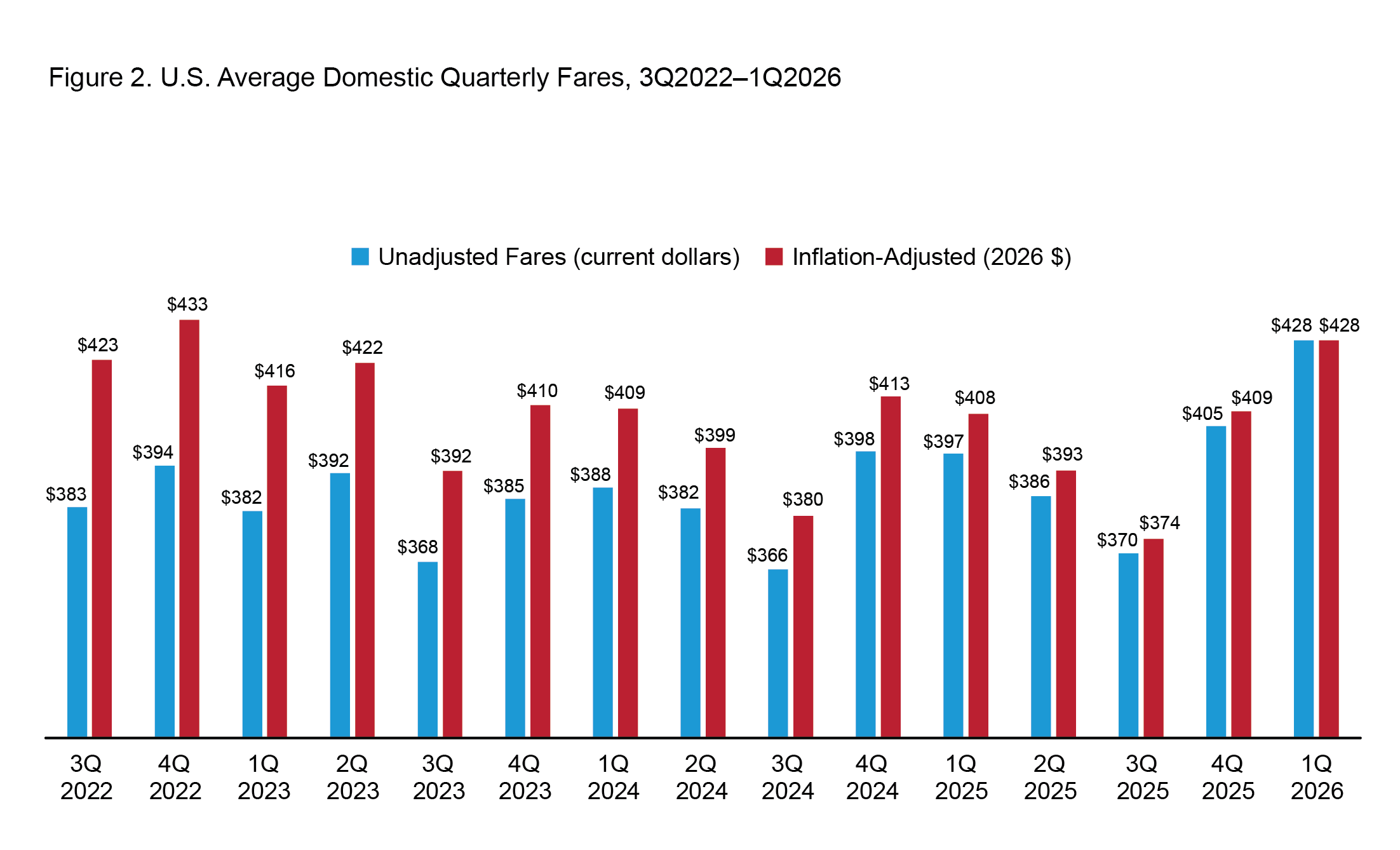
The average U.S. domestic air fare increased in the first quarter of 2026 to $428, up 4.7% from the fourth quarter 2025 inflation-adjusted fare of $409.

Itinerary Fares: Round-trips, but includes one-way tickets if no return is purchased.
Breakout of trip types: one-way, 45% ($305); round-trip, 55% ($522).
Fare calculations by BTS
*Based on a sample of approximately 40% of tickets sold.
Total ticket value: The price charged by airlines at time of ticket purchase.
Included: All fees and charges levied by an air carrier required for the passenger to board the aircraft. Also, additional taxes and fees levied by an outside entity at time of ticket purchase.
Not included: Fees for optional services, such as baggage fees, seat upgrades, and selecting an assigned seat on the aircraft.
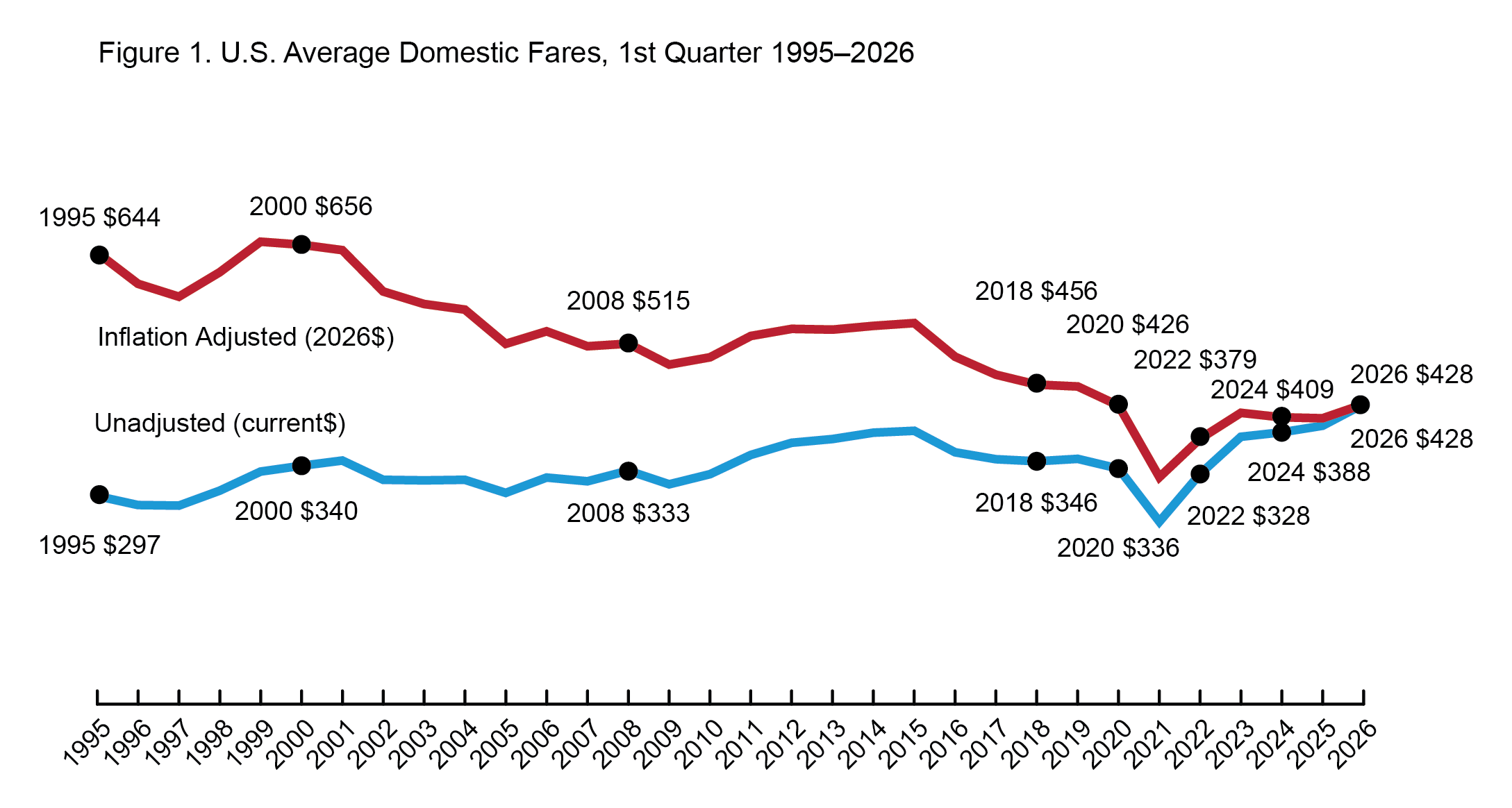
Note: Q3 2025 and forward represents the new OD40% Collection fares
Inflation-Adjusted Average Air Fares
First Quarter 2026 fare ($428):
Compared to all first quarters: Down 35.1% from the highest 1Q fare, $660 in 1999.
Compared to all quarters: Down 35.1% from the highest fare for any quarter, $660 in 1Q 1999.
Start of BTS records: Down 33.6% from 1Q 1995 ($644).
Recent high: Down 3.7% from 2Q 2022 ($444).
Recent low: Up 17.4% from 2Q 2021 ($364).
All-time low: Up 38.7% from the previous low 3Q 2020 ($308).
All-time first quarter low: Up 32.1% from the previous low 1Q 2021 ($324).
Other Revenue: In recent years, airlines have increasingly obtained additional revenue from passenger fees, as well as from other sources. U.S. passenger airlines collected 71.8% of total operating revenue of $45.9 billion from passenger fares during the first three months of 2026, down from 88.5% in 1990.
Unadjusted Average Air Fares
First Quarter 2026 fare ($428):
Trend: Up 5.7% from 4Q 2025 ($405).
Compared to all first quarters: This is the highest Quarter 1 fare recorded, $428.
Compared to all quarters: Up 5.7% from the highest fare for any quarter, $405 in 4Q 2025.
Start of BTS records: Up 44.1% from 1Q 1995 ($297) (compared to 117.02% consumer price increase).
Recent low: Up 42.7% from 2Q 2021 ($300).
Recent high: Up 5.7% from 4Q 2025 ($405).
All-time low: Up 74.8% from 3Q 2020 ($245).
All-time first-quarter low: Up 64.4% from 1Q 2021 ($260).
Fares by Airport
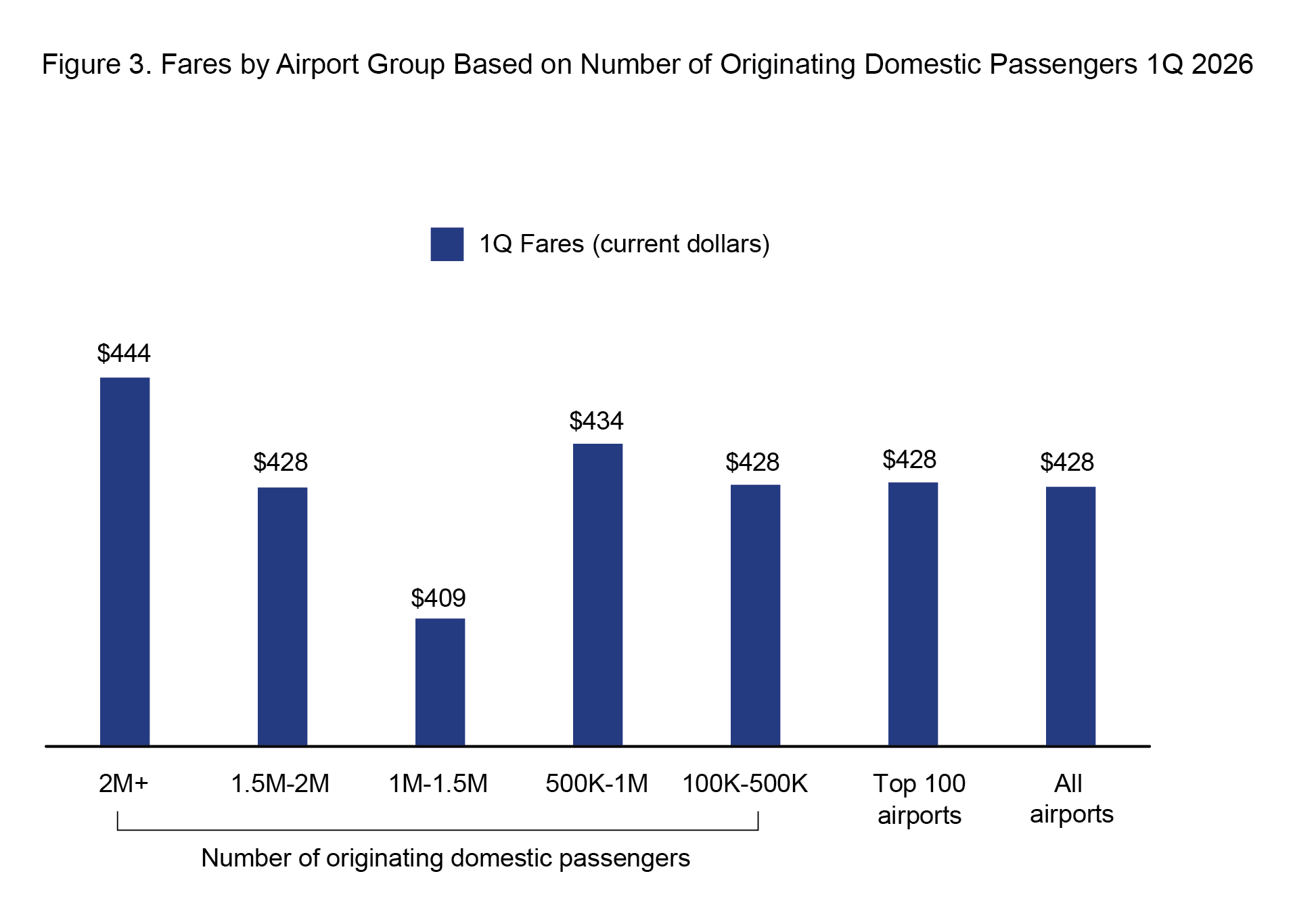
Fares by airport group:
Highest: 5 airports with 2.0 million plus originating passengers ($444)
Lowest: 10 airports with 1.0-1.49 million originating passengers ($409)
Additional data: see Top 100 Airports or All Airports.
The next press release date for second quarter of 2026 is planned for October 15, 2026.
To receive updates from BTS directly to your email, please consider subscribing to our GovDelivery service.