


North American Transborder Freight decreased 5.5% in January 2026 from January 2025
BTS 26-30
This release is published on a fixed schedule as required by the Office of Management and Budget, and statistics in this release may be revised when inputs to the statistics are corrected or updated. Data on the program page of this website are the most up-to-date and complete.
Source: Bureau of Transportation Statistics TransBorder Freight Data.
The transborder freight data program provides comprehensive monthly and annual data on North American cross-border freight activity, detailing the value of U.S. imports and exports with Canada and Mexico by mode of transportation, commodity, and geography. These data inform critical infrastructure planning, trade corridor studies, and logistics research. This data release is for the month of January 2026 and also available online at the BTS Transborder Freight Data page.
Total Transborder Freight by Border in January 2026, Compared to January 2025:
Transborder freight between the U.S. and North American countries Canada and Mexico:
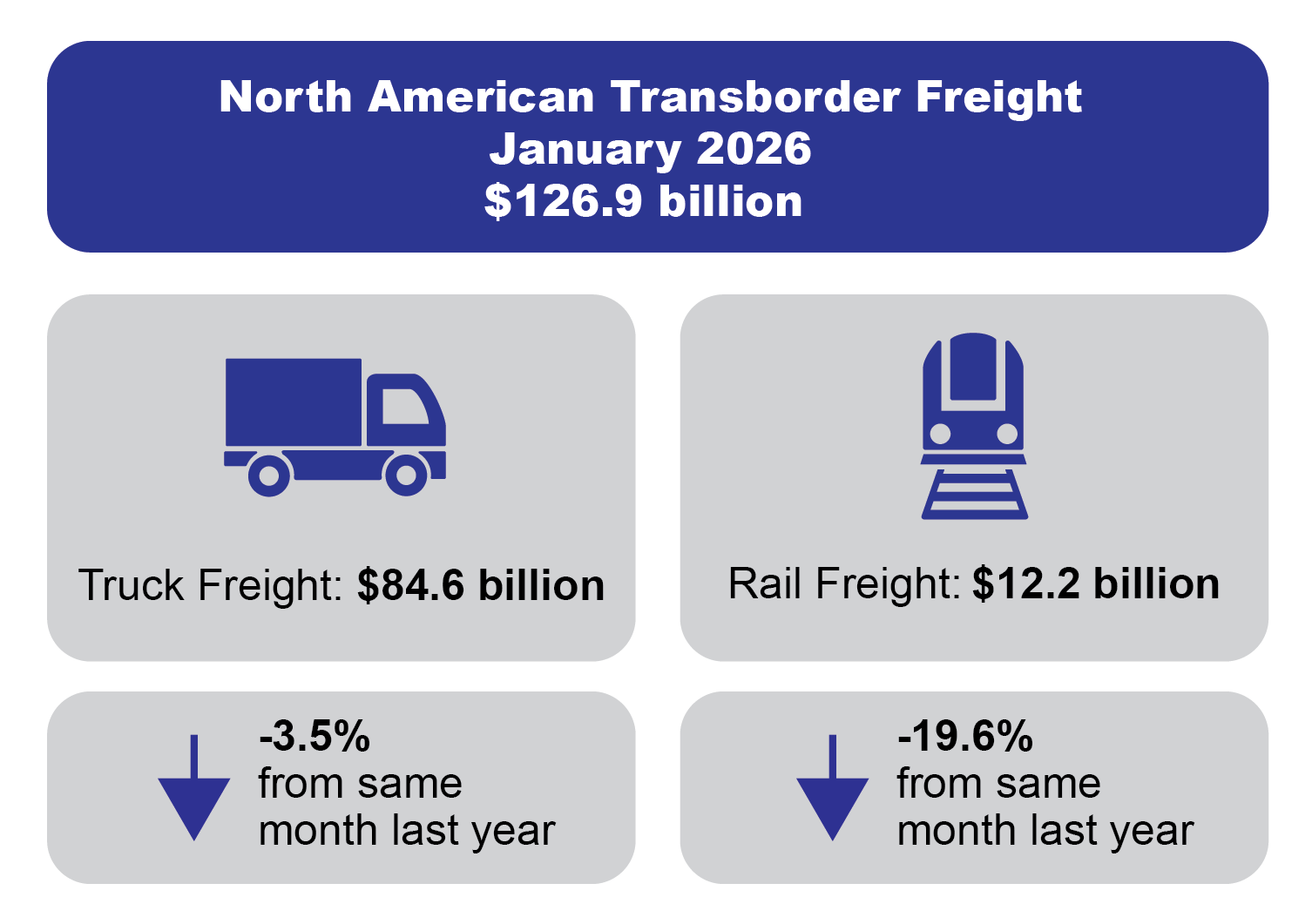
- Total transborder freight: $126.9 billion of transborder freight moved by all modes of transportation, decreasing 5.5% compared to January 2025
- Freight between the U.S. and Canada: $52.8 billion, down 18.4% from January 2025
- Freight between the U.S. and Mexico: $74.1 billion, up 6.5% from January 2025
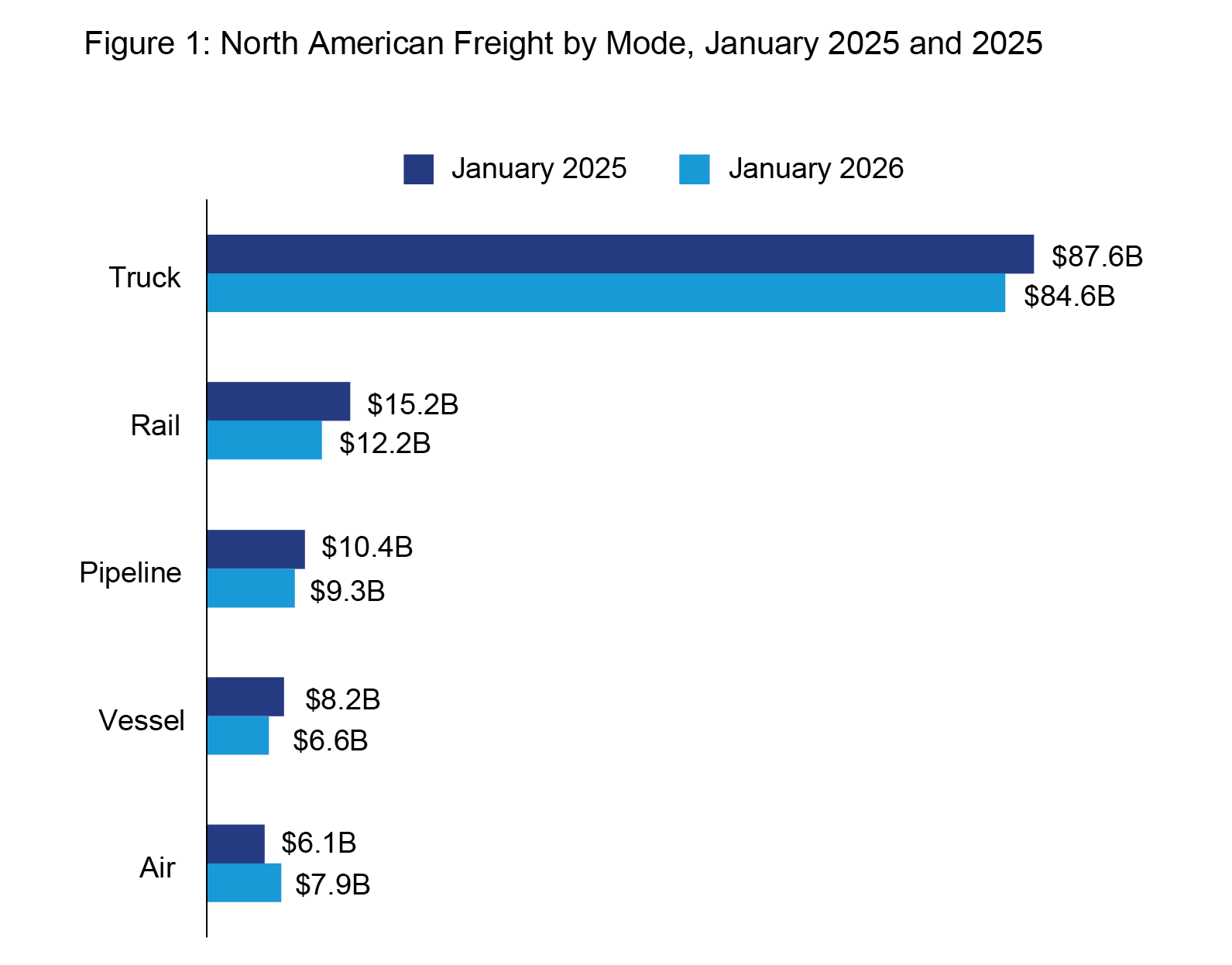
- Trucks moved $84.6 billion of freight, down 3.5% compared to January 2025
- Railways moved $12.2 billion of freight, down 19.6% compared to January 2025
- Pipelines moved $9.3 billion of freight, down 10.3% compared to January 2025
- Air moved $7.9 billion of freight, up 28.1% compared to January 2025
- Vessels moved $6.6 billion of freight, down 19.7% compared to January 2025
Source: Bureau of Transportation Statistics TransBorder Freight Data.
Total Transborder Freight by Border and Mode
| U.S.-Canada (both directions) USD (Billions) |
U.S.-Mexico (both directions) USD (Billions) |
||
|---|---|---|---|
| Truck | $29.6 | Truck | $55.0 |
| Pipeline | $8.3 | Rail | $6.4 |
| Rail | $5.8 | Air | $5.5 |
| Air | $2.4 | Vessel | $4.3 |
| Vessel | $2.3 | Pipeline | $1.0 |
Detroit, Port Huron, and Buffalo are the top truck ports for U.S. freight flows with Canada, while Laredo, El Paso, and Otay Mesa are the top truck ports with Mexico.
Detroit, Port Huron, and International Falls are the top rail connection ports for U.S. freight flows with Canada, while Laredo, Eagle Pass, and El Paso are the top rail connection ports with Mexico.
Chicago, Port Huron, and Minneapolis are the top pipeline connection regions for U.S. energy freight flows with Canada. El Paso, Hidalgo, and Laredo are the top pipeline connection regions with Mexico.
Port of Boston, Arthur, and Portland are the top water port connections for U.S. energy flows with Canada. Port of Houston, Arthur, and Texas City are the top water port connections for U.S. energy flows on the Southern border.
Top 10 Ports and Commodities
| Port | USD | Commodity | USD |
|---|---|---|---|
| Laredo - Texas | 27,338,250,535 | Computer-Related Machinery and Parts | 29,841,480,326 |
| Ysleta - Texas | 10,092,104,790 | Mineral Fuels; Oils and Waxes | 15,670,061,004 |
| Port Huron - Michigan | 8,717,707,842 | Electrical Machinery; Equipment and Parts | 15,271,921,031 |
| Detroit - Michigan | 8,636,910,249 | Vehicles Other than Railway | 14,362,183,019 |
| Buffalo - Niagara Fall - New York | 6,167,506,686 | Plastics and Articles | 4,389,896,858 |
| Otay Mesa - California | 4,522,315,514 | Measuring and Testing Instruments | 3,718,634,921 |
| Santa Teresa - New Mexico | 3,923,361,584 | Pearls; Stones; Metals and Imitation Jewelry | 2,776,428,483 |
| Hidalgo - Texas | 3,736,692,085 | Aircraft; Spacecraft and Parts | 1,788,247,981 |
| El Paso - Texas | 3,051,814,367 | Articles of Iron and Steel | 1,703,336,866 |
| Eagle Pass - Texas | 2,991,222,724 | Furniture; Lamps and Prefabricated Buildings | 1,683,522,930 |
Reporting Notes
All monetary values are in current U.S. dollars and not adjusted for inflation. For previous statistical releases and summary tables, see transborder releases. Visit the transborder freight program homepage for data from previous months, and additional state, port, and commodity data.
To receive updates from BTS directly to your email, please consider subscribing to our GovDelivery service.