


Trucking movements: BTS Freight Mobility Initiative (FMI)
The Bureau of Transportation Statistics’ (BTS) Freight Mobility Initiative (FMI) comprises all experimental statistics and products developed from a database of aggregated, anonymized, non-customer-specific GPS position data (or processed "GPS pings") acquired from the American Transportation Research Institute (ATRI) and harvested from a sample of truck tractors that have been moving around North America since 2018. The metrics generated from this database are part of a larger program at BTS to use probe data to enhance and expand the federal government's suite of statistical products on freight transportation and the movement of trucks around the United States.
The core BTS FMI database contains location and time information logged from a sample of approximately 300,000 unique truck tractors and reflects the movements made by these vehicles within a subset of North America (i.e., the continental United States, Alaska, Hawaii, Puerto Rico, Canada, and a five-mile buffer into Mexico) since October 1, 2018.
The database currently exceeds 500 billion rows, and new data are added to the database bi-weekly. BTS have long-term plans to back-fill commensurate data from 2010 to 2017.
Every row of the database represents one processed GPS "ping" emitted from a truck and contains thirteen (13) attributes.
The first seven (7) attributes of each ping are provided to users exactly as received from ATRI:
- latitude
- longitude
- date-time (UTC)
- vehicle-recorded speed
- vehicle-recorded heading
- a unique, anonymized identification code for each truck with most trucks reporting a position update every one to five minutes.
- FHWA vehicle weight class (1-8)*
BTS then uses these spatial and temporal information to append six (6) additional attributes to each ping:
- Census Bureau county FIPS codes
- time zone
- date-time (local time zone)
- calculated Haversine distance from previous ping
- calculated time since previous ping
- calculated heading from previous ping
The database does not include individual characteristics of the truck that emitted each ping, e.g., size, length, weight, contents/commodity, owner, operator, etc.
* Only available for processed GPS pings received since January 1, 2024.
County to County travel times
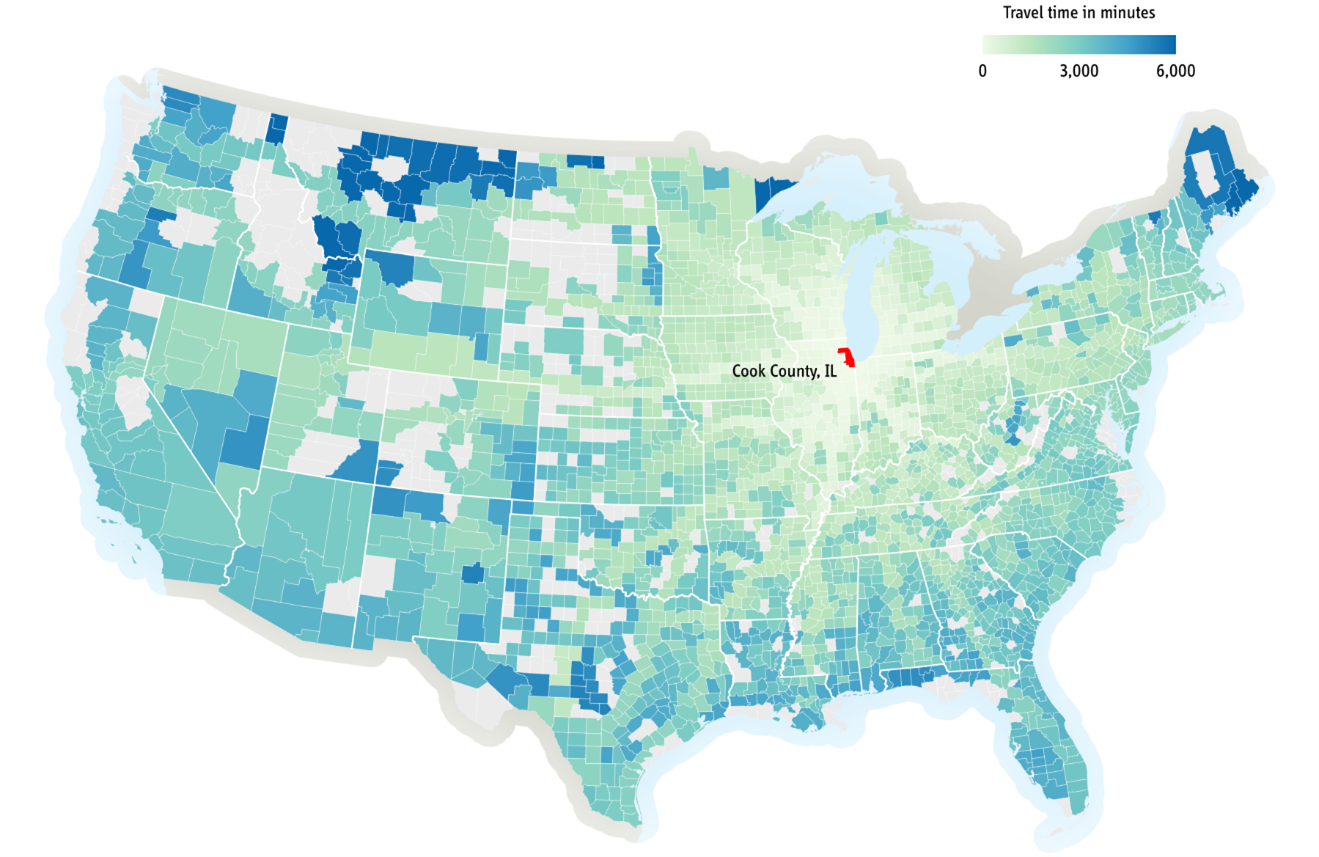
Background
This experimental product estimates the county-to-county travel times observed among the trucks in the BTS FMI database as they traveled throughout North America for each year, 2018-2025. For each unique county pair and year, BTS calculated the 25th, 50th, and 75th percentile travel times among all the instances where a truck was observed moving between them, referencing the total elapsed time (stopped and moving) between the truck’s last ping in the origin county and its first ping in the destination county. A full summary of the methodology underlying this product is available on ROSA-P.
Notes
Please note two elements of this product that were altered for data confidentiality purposes:
- county pairs connected by a truck on fewer than one hundred (100) instances are excluded
- the number of trucks observed on each county pair are indicated using four large bins (100 to 999; 1,000 to 9,999; 10,000 to 99,999; and over 100,000).
Links
- Methodology document: BTS Freight Mobility Initiative: County-to-County Travel Times
- Data downloads:
| Year | Unique county pairs | Download link |
| 2018 | 2.08 million | Download |
| 2019 | 4.13 million | Download |
| 2020 | 4.43 million | Download |
| 2021 | 4.25 million | Download |
| 2022 | 3.81 million | Download |
| 2023 | 3.64 million | Download |
| 2024 | 3.58 million | Download |
| 2025 | 3.35 million | Download |
- What kinds of trucks are represented in the BTS FMI database? The database contains trucks of all FHWA weight classes, but the majority are heavy-duty, fleet-based trucks that belong to FHWA classes 7 and 8. The database has an over-representation of long-distance, fleet trucks and an under-representation of short-distance, drayage trucks. All GPS pings received since January 1, 2024, indicate that truck's class designation.
- What restrictions or limitations exist on the database? BTS FMI data can be used for statistical and research analyses to inform national transportation planning, policy, investment, and operations to freight. BTS FMI data cannot be used or shared for any regulatory, law enforcement, or adjudicatory purpose, or any federal policy initiative whose stated purpose would clearly and directly negatively affect the rights, privileges, or benefits of an identifiable industry.
- Who can access and use the BTS FMI data? Access is strictly limited to federal government employees and their designated contractors. Public products developed from this database are freely accessible, having been reviewed and approved by the BTS data confidentiality officer. BTS FMI data are the property of ATRI and/or its subcontractors and shall not be disclosed to any third party or released into the public domain, and shall not be duplicated, used, or disclosed, in whole or in part, for any purpose other than as may be authorized in writing by ATRI.
- Where are the data stored and analyzed? Authorized users can access the data through the DOT Databricks instance, a secured, high-powered, cloud-based computing platform used to store, analyze, and visualize confidential big data using common scripting languages. Here, users can (1) collaborate with designated team members through code and file sharing and (2) upload and interact with outside data files, including geographic information systems (GIS) layers.
- Can the BTS FMI "ping" data be displayed publicly? BTS FMI ping data cannot leave the secure Databricks environment in an unaltered form, although users can export aggregate analyses performed on the core dataset that have been approved by the BTS data confidentiality officer. Files that directly or indirectly reveal the operations of an individual business must stay on the environment.
If you have any questions about the BTS FMI program, are interested in working with these data, have feedback about one of the experimental statistics, or are interested in other potential applications of the data, please consult the following resources:
- For questions about BTS publications and data products—including any methodological publications related to BTS FMI products—contact the BTS National Transportation Library.
- The BTS Freight Mobility Initiative (FMI) Team is available at btsfmi@dot.gov.