


2018 Traffic Data for U.S Airlines and Foreign Airlines U.S. Flights
NOTE: If you are looking for 2019 Full-Year Traffic Data for U.S. Airlines and Foreign Airlines, that information can be found in BTS release 14-20.
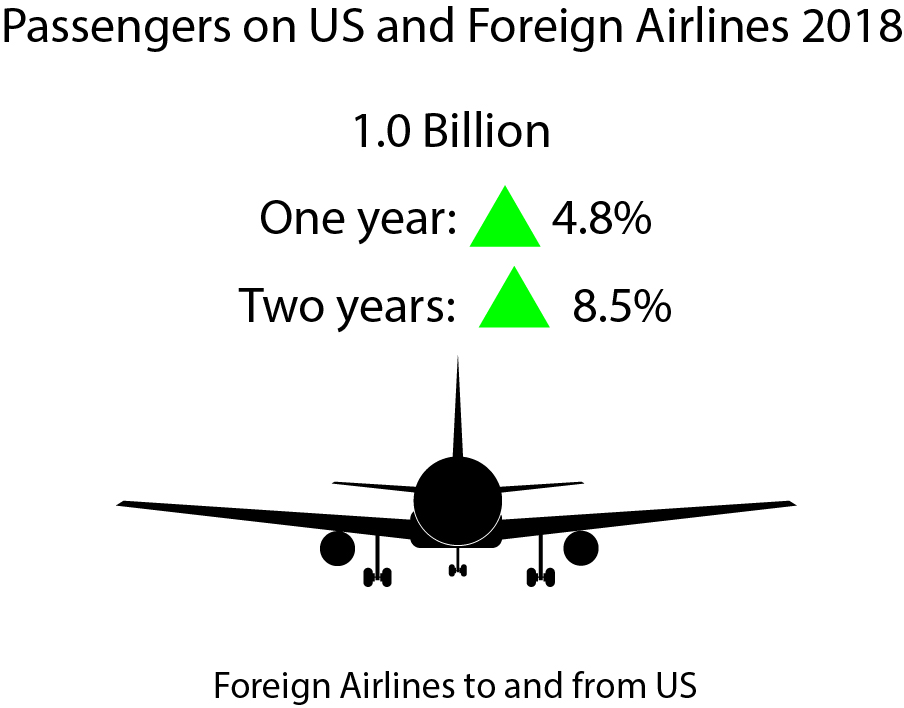
U.S. airlines and foreign airlines serving the U.S. carried an all-time high of 1.0 billion systemwide (domestic and international) scheduled service passengers in 2018, 4.8 percent more than the previous record high of 965.4 million reached in 2017. The year-over-year systemwide increase resulted from a 4.9 percent rise in the number of passengers on domestic flights (777.9 million passengers in 2018) and 4.4 percent growth in passengers on U.S. and foreign airlines’ flights to and from the U.S. (233.6 million passengers in 2018) (Tables 1, 1A, 5, 9). Systemwide passengers include those on scheduled domestic flights plus those on scheduled flights to and from the United States.
Annual Passengers on All U.S. Scheduled Airline Flights (Domestic & International) and Foreign Airline Flights to and from the United States, 2003-2018
| Year | Total | Domestic | International | 1 |
|---|---|---|---|---|
| 2003 | 700.9 | 583.3 | 117.6 | 2 |
| 2004 | 763.7 | 629.8 | 133.9 | 3 |
| 2005 | 800.8 | 657.3 | 143.6 | 4 |
| 2006 | 808.1 | 658.4 | 149.7 | 5 |
| 2007 | 835.5 | 679.2 | 156.3 | 6 |
| 2008 | 809.8 | 651.7 | 158.1 | 7 |
| 2009 | 767.8 | 618.1 | 149.7 | 8 |
| 2010 | 787.5 | 629.5 | 157.9 | 9 |
| 2011 | 802.1 | 638.2 | 163.9 | 10 |
| 2012 | 813.1 | 642.3 | 170.8 | 11 |
| 2013 | 825.3 | 645.7 | 179.6 | 12 |
| 2014 | 851.8 | 662.8 | 189.0 | 13 |
| 2015 | 896.6 | 696.0 | 200.6 | 14 |
| 2016 | 932.0 | 720.0 | 212.0 | 15 |
| 2017 | 965.4 | 741.7 | 223.7 | 16 |
| 2018 | 1,011.5 | 777.9 | 233.6 | 17 |
| 18 |
Bureau of Transportation Statistics, T-100 Market (All Carriers)
SOURCE for Recession Dates: National Bureau of Economic Research, US Business Cycle Expansions and Contractions
U.S. airlines carried 4.9 percent more passengers on domestic flights and 3.1 percent more passengers on international flights in 2018 than in 2017 for a systemwide increase of 4.7 percent. Foreign airlines carried 5.6 percent more passengers to and from the U.S. than in 2017. The 233.6 million passengers on international flights to and from the U.S. was a record high, exceeding the previous high set in 2017 (Tables 1A, 1B, 5, 9).
This annual release includes preliminary data on U.S. carrier scheduled domestic and international service, including from one foreign point to another foreign point, and foreign carrier scheduled international service to and from the U.S. BTS monthly air traffic releases include data on U.S. carrier scheduled service only.
Domestic load factor fell 0.1 points as demand, measured in RPMs, rose 5.4 percent, slightly less than the 5.5 percent growth in capacity measured in ASMs (Table 5).
Demand on international flights, measured in RPMs, rose 5.0 percent, more than the 3.7 percent growth in capacity measured in ASMs. The result was a 1.0 point rise in the international load factor to 81.7 from 80.6 in 2017 (Table 9).
For annual airline and airport statistics, the accompanying Tables 1 through 4 provide combined domestic and international travel statistics, Tables 5 through 8 provide domestic travel statistics and Tables 9 through 12 provide international travel statistics.
Go to the complete list of reporting and non-reporting carriers. Figure 1 numbers begin with 2003, the first full year of data following a reporting change that went into effect in October 2002. U.S. carriers’ foreign point-to-point flights are included in system and international totals. To create a customized table for U.S. carrier passengers, flights, RPMs, ASMs and other data, including non-scheduled service, go to BTS Air Carrier Traffic Statistics.
For additional scheduled service numbers for U.S. and foreign airlines, by airline and by airport, see Passengers, Flights, Revenue Passenger-Miles, Available Seat-Miles and Load Factor.
Traffic numbers are available on the BTS website at TranStats. Click on “Aviation.” For U.S. carrier systemwide passengers, RPMs and ASMs by carrier through December, click on “Air Carrier Summary Data (Form 41 and 298C Summary Data),” and then click on “Schedule T-1.” Use crosstabs to find scheduled service.
For domestic numbers through December and international numbers through September by origin as well as by carrier, click on “Aviation,” then click on “Air Carrier Statistics (Form 41 Traffic).” Click on “T-100 Market” for system passenger numbers, “T-100 Domestic Market” for domestic or “T-100 International Market” for international. For flights, stage length and trip length, use the appropriate T-100 Segment database. Use crosstabs to find scheduled service.
Complete international data for the full year 2018 will be released on June 13.
None of the data are from samples so measures of statistical significance do not apply. Data in this press release are not seasonally adjusted.
Table 1. Scheduled Systemwide (Domestic and International) Airline Travel on U.S. and Foreign Airlines, 2017-2018
| Annual | 1 | |||
|---|---|---|---|---|
| 2017 | 2018 | Change % | 2 | |
| Passengers (in millions) | 965.4 | 1,011.5 | 4.8 | 3 |
| Flights (in thousands) | 9,761.4 | 10,012.3 | 2.6 | 4 |
| Revenue Passenger Miles (in billions) | 1,436.8 | 1,511.7 | 5.2 | 5 |
| Available Seat-Miles (in billions) | 1,742.4 | 1,822.0 | 4.6 | 6 |
| Load Factor* | 82.5 | 83.0 | 0.5 | 7 |
| Flight Stage Length** | 984.4 | 995.8 | 1.2 | 8 |
| Passenger Trip Length*** | 1,488.3 | 1,494.6 | 0.4 | 9 |
| 10 |
Bureau of Transportation Statistics, T-100 Market and Segment
Table 1A. Annual Enplanements on U.S. Carriers and on Foreign Carriers' U.S. Flights 2017-2018
| 2017 | 2018 | Change % | 1 | ||
|---|---|---|---|---|---|
| U.S. Carrier | Domestic | 741.7 | 777.9 | 4.9 | 2 |
| International | 107.7 | 111.1 | 3.1 | 3 | |
| System | 849.4 | 889.0 | 4.7 | 4 | |
| Foreign Carrier | To and From U.S. | 116.0 | 122.5 | 5.6 | 5 |
| Total | 965.4 | 1,011.5 | 4.8 | 6 | |
| 7 |
Bureau of Transportation Statistics, T-100 Market
Table 1B. 2018 Passengers on U.S. and Foreign Airlines by Origin and Destination
| Destination | 1 | |||||
|---|---|---|---|---|---|---|
| Domestic | Foreign | 2 | ||||
| Origin | Domestic | Domestic carriers | 785.5 | Domestic carriers | 55.3 | 3 |
| Foreign Carriers | N/A | Foreign Carriers | 63.0 | 4 | ||
| Foreign | Domestic carriers | 55.4 | Domestic carriers | 0.6 | 5 | |
| Foreign Carriers | 62.5 | Foreign Carriers* | N/A | 6 | ||
| 7 |
* Foreign carriers do not report to the Bureau of Transportation Statistics on flights without a U.S. origin or destination
Bureau of Transportation Statistics, T-100 Market (All Carriers)
Table 2. Monthly Systemwide (Domestic and International) Scheduled Enplanements on U.S. and Foreign Airlines, 2016-2018
| 2016 | 2017 | 2016-2017 Pct. Change | 2018 | 2017-2018 Pct. Change | 1 | |
|---|---|---|---|---|---|---|
| January | 69.1 | 71.7 | 3.7 | 73.7 | 2.8 | 2 |
| February | 65.6 | 65.8 | 0.3 | 69.8 | 6.0 | 3 |
| March | 79.1 | 81.9 | 3.6 | 86.3 | 5.4 | 4 |
| April | 75.6 | 79.9 | 5.6 | 83.6 | 4.7 | 5 |
| May | 80.7 | 83.4 | 3.3 | 87.9 | 5.5 | 6 |
| June | 84.3 | 87.5 | 3.8 | 92.3 | 5.5 | 7 |
| July | 87.7 | 91.3 | 4.2 | 96.1 | 5.2 | 8 |
| August | 84.3 | 88.7 | 5.3 | 93.0 | 4.8 | 9 |
| September | 75.9 | 74.6 | -1.6 | 78.5 | 5.1 | 10 |
| October | 78.7 | 82.3 | 4.5 | 85.3 | 3.7 | 11 |
| November | 75.0 | 78.4 | 4.6 | 82.1 | 4.6 | 12 |
| December | 77.3 | 79.9 | 3.4 | 82.9 | 3.8 | 13 |
| Yr. Total | 933.1 | 965.4 | 3.5 | 1,011.5 | 4.8 | 14 |
| 15 |
Percentage changes based on numbers prior to rounding.
Bureau of Transportation Statistics, T-100 Market
Table 3. Top 10 Airlines, ranked by 2018 System* Scheduled Enplanements
| 2018 Rank | Carrier | 2018 Enplaned Passengers | 2017 Rank | 2017 Enplaned Passengers | Pct. Change 2017-2018 | 1 |
|---|---|---|---|---|---|---|
| 1 | Southwest | 163.606 | 1 | 157.677 | 3.8 | 2 |
| 2 | Delta | 152.029 | 2 | 145.647 | 4.4 | 3 |
| 3 | American | 148.181 | 3 | 144.864 | 2.3 | 4 |
| 4 | United | 113.197 | 4 | 107.243 | 5.6 | 5 |
| 5 | JetBlue | 42.236 | 5 | 40.015 | 5.5 | 6 |
| 6 | SkyWest | 38.956 | 6 | 35.776 | 8.9 | 7 |
| 7 | Alaska | 33.503 | 7 | 26.067 | 28.5 | 8 |
| 8 | Spirit | 28.683 | 8 | 23.813 | 20.5 | 9 |
| 9 | Frontier | 19.433 | 10 | 16.800 | 15.7 | 10 |
| 10 | Republic | 18.640 | 9 | 16.932 | 10.1 | 11 |
| 12 |
Bureau of Transportation Statistics, T-100 Market
Table 4. Top 10 U.S. Airports, ranked by 2018 System* Scheduled Enplanements on U.S. and Foreign Airlines
| 2018 Rank | Airport | 2018 Enplaned Passengers | 2017 Rank | 2017 Enplaned Passengers | Pct. Change 2017-2018 | 1 |
|---|---|---|---|---|---|---|
| 1 | Atlanta | 51.844 | 1 | 50.243 | 3.2 | 2 |
| 2 | Los Angeles | 42.578 | 2 | 41.201 | 3.3 | 3 |
| 3 | Chicago O'Hare | 39.851 | 3 | 38.577 | 3.3 | 4 |
| 4 | Dallas/Fort Worth | 32.780 | 4 | 31.794 | 3.1 | 5 |
| 5 | Denver | 31.341 | 5 | 29.787 | 5.2 | 6 |
| 6 | New York JFK | 30.489 | 6 | 29.490 | 3.4 | 7 |
| 7 | San Francisco | 27.770 | 7 | 26.892 | 3.3 | 8 |
| 8 | Seattle | 23.977 | 9 | 22.604 | 6.1 | 9 |
| 9 | Las Vegas | 23.593 | 8 | 23.150 | 1.9 | 10 |
| 10 | Orlando | 23.155 | 11 | 21.542 | 7.5 | 11 |
| 12 |
Bureau of Transportation Statistics, T-100 Market
Table 5. Domestic Scheduled Airline Travel on U.S. Airlines, 2017-2018
| Annual | 1 | |||
|---|---|---|---|---|
| 2017 | 2018 | Change % | 2 | |
| Passengers (in millions) | 741.7 | 777.9 | 4.9 | 3 |
| Flights (in thousands) | 8,177.6 | 8,391.4 | 2.6 | 4 |
| Revenue Passenger Miles (in billions) | 684.2 | 721.2 | 5.4 | 5 |
| Available Seat-Miles (in billions) | 809.1 | 854.0 | 5.5 | 6 |
| Load Factor* | 84.6 | 84.5 | -0.1 | 7 |
| Flight Stage Length** | 710.0 | 721.0 | 1.5 | 8 |
| Passenger Trip Length*** | 922.5 | 927.1 | 0.5 | 9 |
| 10 |
Bureau of Transportation Statistics, T-100 Domestic Market and Segment
Table 6. Monthly Domestic Scheduled Enplanements on U.S. Airlines, 2016-2018
| 2016 | 2017 | 2016-2017 Pct. Change | 2018 | 2017-2018 Pct. Change | 1 | |
|---|---|---|---|---|---|---|
| January | 52.5 | 54.1 | 3.1 | 55.8 | 3.2 | 2 |
| February | 51.1 | 51.1 | -0.1 | 54.1 | 5.9 | 3 |
| March | 61.6 | 64.0 | 3.8 | 66.6 | 4.2 | 4 |
| April | 58.9 | 61.1 | 3.7 | 64.6 | 5.7 | 5 |
| May | 62.8 | 64.4 | 2.7 | 67.8 | 5.3 | 6 |
| June | 64.8 | 66.7 | 3.1 | 70.3 | 5.3 | 7 |
| July | 66.1 | 68.6 | 3.7 | 72.5 | 5.8 | 8 |
| August | 63.5 | 66.7 | 5.0 | 70.3 | 5.5 | 9 |
| September | 58.6 | 57.1 | -2.5 | 60.5 | 5.8 | 10 |
| October | 61.7 | 64.6 | 4.7 | 67.1 | 3.8 | 11 |
| November | 59.3 | 61.9 | 4.5 | 64.6 | 4.4 | 12 |
| December | 59.2 | 61.4 | 3.7 | 63.6 | 3.7 | 13 |
| Yr. Total | 720.0 | 741.7 | 3.0 | 777.9 | 4.9 | 14 |
| 15 |
Percentage changes based on numbers prior to rounding.
Bureau of Transportation Statistics, T-100 Domestic Market
Table 7. Top 10 Airlines, ranked by 2018 Domestic Scheduled Enplanements
| 2018 Rank | Carrier | 2018 Enplaned Passengers | 2017 Rank | 2017 Enplaned Passengers | Pct. Change 2017-2018 | 1 |
|---|---|---|---|---|---|---|
| 1 | Southwest | 159.045 | 1 | 153.809 | 3.4 | 2 |
| 2 | Delta | 126.473 | 2 | 120.735 | 4.8 | 3 |
| 3 | American | 119.471 | 3 | 116.471 | 2.6 | 4 |
| 4 | United | 85.896 | 4 | 80.434 | 6.8 | 5 |
| 5 | SkyWest | 37.427 | 5 | 34.054 | 9.9 | 6 |
| 6 | JetBlue | 33.965 | 6 | 32.394 | 4.8 | 7 |
| 7 | Alaska | 31.493 | 7 | 24.063 | 30.9 | 8 |
| 8 | Spirit | 26.319 | 8 | 21.971 | 19.8 | 9 |
| 9 | Frontier | 18.669 | 9 | 15.970 | 16.9 | 10 |
| 10 | Republic | 17.594 | 10 | 15.787 | 11.4 | 11 |
| 12 |
Percentage changes based on numbers prior to rounding.
Bureau of Transportation Statistics, T-100 Domestic Market
Table 8. Top 10 U.S. Airports, ranked by 2018 Domestic Scheduled Enplanements
| 2018 Rank | Airport | 2018 Enplaned Passengers | 2017 Rank | 2017 Enplaned Passengers | Pct. Change 2017-2018 | 1 |
|---|---|---|---|---|---|---|
| 1 | Atlanta | 45.711 | 1 | 44.351 | 3.1 | 2 |
| 2 | Chicago O'Hare | 33.144 | 2 | 32.189 | 3.0 | 3 |
| 3 | Los Angeles | 30.008 | 3 | 29.142 | 3.0 | 4 |
| 4 | Denver | 29.883 | 4 | 28.503 | 4.8 | 5 |
| 5 | Dallas/Fort Worth | 28.641 | 5 | 27.730 | 3.3 | 6 |
| 6 | Las Vegas | 21.812 | 6 | 21.382 | 2.0 | 7 |
| 7 | Seattle | 21.381 | 10 | 20.132 | 6.2 | 8 |
| 8 | San Francisco | 20.995 | 8 | 20.437 | 2.7 | 9 |
| 9 | Charlotte | 20.715 | 7 | 20.493 | 1.1 | 10 |
| 10 | Phoenix | 20.580 | 9 | 20.144 | 2.2 | 11 |
| 12 |
Percentage changes based on numbers prior to rounding.
Bureau of Transportation Statistics, T-100 Domestic Market
Table 9. International Scheduled Airline Travel on U.S. and Foreign Airlines, 2017-2018
| Annual | 1 | |||
|---|---|---|---|---|
| 2017 | 2018 | Change % | 2 | |
| Passengers (in millions) | 223.7 | 233.6 | 4.4 | 3 |
| Flights (in thousands) | 1,583.8 | 1,621.0 | 2.3 | 4 |
| Revenue Passenger Miles (in billions) | 752.6 | 790.5 | 5.0 | 5 |
| Available Seat-Miles (in billions) | 933.3 | 968.0 | 3.7 | 6 |
| Load Factor* | 80.6 | 81.7 | 1.0 | 7 |
| Flight Stage Length** | 2,401.1 | 2,418.3 | 0.7 | 8 |
| Passenger Trip Length*** | 3,364.9 | 3,384.4 | 0.6 | 9 |
| 10 |
Bureau of Transportation Statistics, T-100 International Market and Segment
Table 10. Monthly International Scheduled Enplanements on U.S. and Foreign Airlines, 2016-2018
| 2016 | 2017 | 2016-2017 Pct. Change | 2018 | 2017-2018 Pct. Change | 1 | |
|---|---|---|---|---|---|---|
| January | 16.6 | 17.5 | 5.7 | 17.9 | 1.8 | 2 |
| February | 14.5 | 14.8 | 1.6 | 15.7 | 6.3 | 3 |
| March | 17.5 | 18.0 | 2.7 | 19.7 | 9.6 | 4 |
| April | 16.7 | 18.8 | 12.3 | 19.1 | 1.8 | 5 |
| May | 18.0 | 18.9 | 5.3 | 20.1 | 6.2 | 6 |
| June | 19.5 | 20.7 | 6.3 | 22.0 | 6.2 | 7 |
| July | 21.5 | 22.7 | 5.6 | 23.5 | 3.5 | 8 |
| August | 20.8 | 22.1 | 6.3 | 22.6 | 2.5 | 9 |
| September | 17.3 | 17.5 | 1.3 | 18.0 | 3.0 | 10 |
| October | 17.0 | 17.7 | 3.9 | 18.3 | 3.5 | 11 |
| November | 15.7 | 16.5 | 5.1 | 17.4 | 5.6 | 12 |
| December | 18.1 | 18.5 | 2.4 | 19.3 | 4.1 | 13 |
| Yr. Total | 213.1 | 223.7 | 4.9 | 233.6 | 4.4 | 14 |
| 15 |
Percentage changes based on numbers prior to rounding.
Bureau of Transportation Statistics, T-100 International Market
Table 11. Top 10 Airlines, ranked by 2018 International Scheduled Enplanements
| 2018 Rank | Carrier | 2018 Enplaned Passengers | 2017 Rank | 2017 Enplaned Passengers | Pct. Change 2017-2018 | 1 |
|---|---|---|---|---|---|---|
| 1 | American | 28,710.0 | 1 | 28,392.1 | 1.1 | 2 |
| 2 | United | 27,301.0 | 2 | 26,808.3 | 1.8 | 3 |
| 3 | Delta | 25,555.9 | 3 | 24,911.9 | 2.6 | 4 |
| 4 | JetBlue | 8,270.7 | 4 | 7,621.0 | 8.5 | 5 |
| 5 | British Air | 6,803.4 | 5 | 7,072.6 | -3.8 | 6 |
| 6 | Lufthansa | 6,114.4 | 6 | 5,940.5 | 2.9 | 7 |
| 7 | Air Canada | 5,239.1 | 8 | 4,908.8 | 6.7 | 8 |
| 8 | WestJet | 4,949.1 | 7 | 5,036.1 | -1.7 | 9 |
| 9 | Southwest | 4,560.7 | 9 | 3,868.2 | 17.9 | 10 |
| 10 | Virgin Atlantic | 3,776.8 | 12 | 3,552.7 | 6.3 | 11 |
| 12 |
Percentage changes based on numbers prior to rounding.
Bureau of Transportation Statistics, T-100 International Market
Table 12. Top 10 U.S. Airports, ranked by 2018 International Scheduled Enplanements on U.S. and Foreign Airlines
| 2018 Rank | Airport | 2018 Enplaned Passengers | 2017 Rank | 2017 Enplaned Passengers | Pct. Change 2017-2018 | 1 |
|---|---|---|---|---|---|---|
| 1 | New York JFK | 16,459.9 | 1 | 16,058.6 | 2.5 | 2 |
| 2 | Los Angeles | 12,570.6 | 2 | 12,059.2 | 4.2 | 3 |
| 3 | Miami | 10,147.5 | 3 | 10,159.2 | -0.1 | 4 |
| 4 | Newark | 6,849.6 | 6 | 6,263.6 | 9.4 | 5 |
| 5 | San Francisco | 6,775.3 | 4 | 6,455.1 | 5.0 | 6 |
| 6 | Chicago O'Hare | 6,707.4 | 5 | 6,387.9 | 5.0 | 7 |
| 7 | Atlanta | 6,133.5 | 7 | 5,891.7 | 4.1 | 8 |
| 8 | Houston Bush | 5,236.5 | 8 | 5,048.8 | 3.7 | 9 |
| 9 | Fort Lauderdale | 4,158.7 | 11 | 3,500.4 | 18.8 | 10 |
| 10 | Dallas/Fort Worth | 4,138.7 | 9 | 4,064.6 | 1.8 | 11 |
| 12 |
Percentage changes based on numbers prior to rounding.
Bureau of Transportation Statistics, T-100 International Market