


February 2019 Freight Transportation Services Index (TSI)
The Freight Transportation Services Index (TSI), which is based on the amount of freight carried by the for-hire transportation industry, fell 0.5 percent in February from January, falling after a one month increase. For the 12 months ending in February 2019, the index rose 3.2 percent compared to 6.7 percent for the previous 12-month period (Table 4).
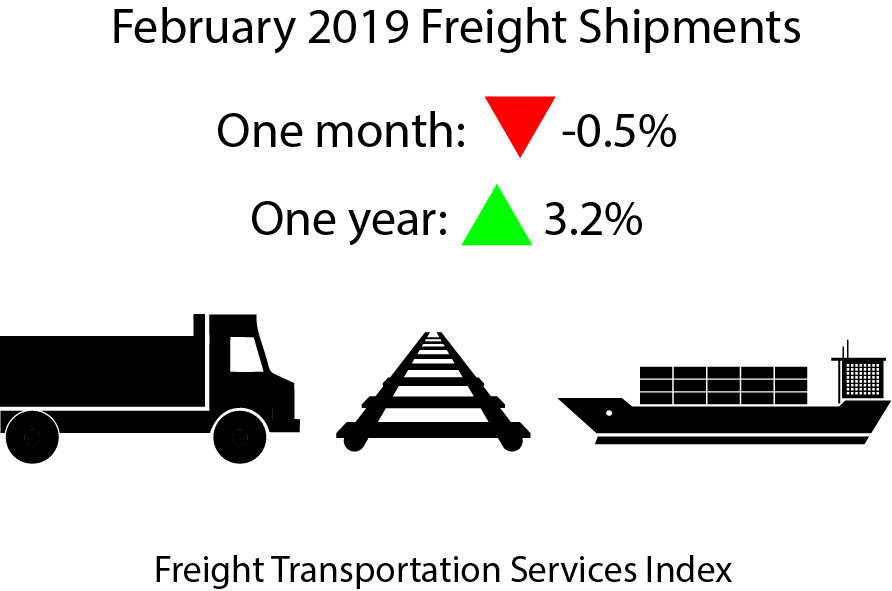
The level of for-hire freight shipments in February measured by the Freight TSI (136.9) was 1.1 percent below the all-time high level of 138.4 in November 2018 (Table 2A). BTS’ TSI records begin in 2000. See historical TSI data.
Freight Transportation Services Index, February 2014 - February 2019
| Month | Freight TSI | 1 |
|---|---|---|
| Feb-14 | 117.9 | 2 |
| Mar-14 | 119.9 | 3 |
| Apr-14 | 120.5 | 4 |
| May-14 | 120.9 | 5 |
| Jun-14 | 119.7 | 6 |
| Jul-14 | 120.4 | 7 |
| Aug-14 | 120.9 | 8 |
| Sep-14 | 121.9 | 9 |
| Oct-14 | 122.5 | 10 |
| Nov-14 | 123.3 | 11 |
| Dec-14 | 123.2 | 12 |
| Jan-15 | 122.9 | 13 |
| Feb-15 | 121.6 | 14 |
| Mar-15 | 122.5 | 15 |
| Apr-15 | 121.4 | 16 |
| May-15 | 121.7 | 17 |
| Jun-15 | 121.3 | 18 |
| Jul-15 | 122.3 | 19 |
| Aug-15 | 123.0 | 20 |
| Sep-15 | 123.0 | 21 |
| Oct-15 | 122.5 | 22 |
| Nov-15 | 120.9 | 23 |
| Dec-15 | 120.4 | 24 |
| Jan-16 | 122.1 | 25 |
| Feb-16 | 121.4 | 26 |
| Mar-16 | 120.1 | 27 |
| Apr-16 | 122.3 | 28 |
| May-16 | 121.6 | 29 |
| Jun-16 | 122.2 | 30 |
| Jul-16 | 125.2 | 31 |
| Aug-16 | 122.9 | 32 |
| Sep-16 | 121.7 | 33 |
| Oct-16 | 122.6 | 34 |
| Nov-16 | 123.2 | 35 |
| Dec-16 | 124.1 | 36 |
| Jan-17 | 123.8 | 37 |
| Feb-17 | 124.4 | 38 |
| Mar-17 | 124.3 | 39 |
| Apr-17 | 124.7 | 40 |
| May-17 | 124.9 | 41 |
| Jun-17 | 125.2 | 42 |
| Jul-17 | 127.6 | 43 |
| Aug-17 | 128.3 | 44 |
| Sep-17 | 127.6 | 45 |
| Oct-17 | 129.2 | 46 |
| Nov-17 | 131.2 | 47 |
| Dec-17 | 132.4 | 48 |
| Jan-18 | 130.4 | 49 |
| Feb-18 | 132.7 | 50 |
| Mar-18 | 134.5 | 51 |
| Apr-18 | 134.5 | 52 |
| May-18 | 135.7 | 53 |
| Jun-18 | 136.3 | 54 |
| Jul-18 | 135.3 | 55 |
| Aug-18 | 135.3 | 56 |
| Sep-18 | 136.3 | 57 |
| Oct-18 | 138.0 | 58 |
| Nov-18 | 138.4 | 59 |
| Dec-18 | 136.4 | 60 |
| Jan-19 | 137.6 | 61 |
| Feb-19 | 136.9 | 62 |
| 63 |
Bureau of Transportation Statistics
The January index was revised to 137.6 from 136.8 in last month’s release.
The Bureau of Transportation Statistics’ Freight TSI measures the month-to-month changes in for-hire freight shipments by mode of transportation in tons and ton-miles, which are combined into one index. The index measures the output of the for-hire freight transportation industry and consists of data from for-hire trucking, rail, inland waterways, pipelines and air freight. The TSI is seasonally-adjusted to remove regular seasons from month-to-month comparisons.
Analysis: The February decline in Freight TSI was driven by decreases in rail carloads, rail intermodal, and water, while air freight, pipeline and trucking grew. The TSI decrease took place against a background of weak results for other indicators. The Federal Reserve Board Industrial Production index increased by 0.1% in February, with a decrease in manufacturing and increases in mining and utilities. Personal income increased by 0.2%, while housing starts declined by 8.7%. The Institute for Supply Management Manufacturing index declined to 54.2, indicating continued but decelerating growth.
Trend: The Freight TSI has declined 1.1% since reaching an all-time high in November 2018 with two decreases in three months. Despite the declines, the Freight TSI remained above its September 2018 level and the level of all previous months. It has increased in nine of the last 12 months for a total increase of 3.2% over its level of one year ago in February 2018. The February index was 44.4% above the April 2009 low during the most recent recession.For additional historical data, go to TSI data.
Index highs and lows: For-hire freight shipments in February 2019 (136.9) were 44.4 percent higher than the low in April 2009 during the recession (94.8). The February 2019 level was 1.1 percent below the historic peak reached in November 2018 (138.4) (Table 1A).
Year to date: For-hire freight shipments measured by the index were up 0.4 percent in February compared to the end of 2018 (Table 3).
Long-term trend: For-hire freight shipments are up 16.1 percent in the five years from February 2014 and are up 35.5 percent in the 10 years from February 2009 (Table 5).
Same month of previous year: February 2019 for-hire freight shipments were up 3.2 percent from February 2018 (Tables 4, 5).
The TSI has three seasonally-adjusted indexes that measure changes from the monthly average of the base year of 2000. The three indexes are freight shipments, passenger travel and a combined measure that merges the freight and passenger indexes. See Seasonally-Adjusted Transportation Data for numbers for individual modes. TSI includes data from 2000 to the present. Release of the March 2019 index is scheduled for May 8.
Passenger Index: The TSI for passengers rose 0.5 percent in February from its January level (Table 6). The Passenger TSI February 2019 level of 130.4 was 1.2 percent above the February 2018 level (Table 7). The index is up 10.2 percent in five years and up 18.0 percent in 10 years (Table 5). The passenger TSI measures the month-to-month changes in travel that involves the services of the for-hire passenger transportation sector. The seasonally-adjusted index consists of data from air, local transit and intercity rail.
Combined Index: The combined freight and passenger TSI fell 0.1 percent in February from its January level (Table 8). The combined TSI February 2019 level of 134.8 was 2.5 percent above the February 2018 level (Table 9). The combined index is up 14.1 percent in five years and up 29.7 percent in 10 years (Table 5). The combined TSI merges the freight and passenger indexes into a single index.
Revisions: Monthly data has changed from previous releases due to the use of concurrent seasonal analysis, which results in seasonal analysis factors changing as each month’s data are added.
BTS research has shown a clear relationship between economic cycles and the Freight and Passenger Transportation Services Indexes. See a study of this relationship using smoothed and detrended TSI data. Researchers who wish to compare TSI over time with other economic indicators, can use the FRED database, which includes freight, passenger and combined TSI, and which makes it possible to easily graph TSI alongside the other series in that database. See TSI data on FRED.
A BTS report explaining the TSI, Transportation Services Index and the Economy, is available for download.
Table 1: Freight, Passenger and Combined Transportation Services Indexes Since August 2018, February 2019
| Freight | Passenger | Combined | 1 | ||||
|---|---|---|---|---|---|---|---|
| Index | Pct. Change | Index | Pct. Change | Index | Pct. Change | 2 | |
| August | 135.3 | 0.0 | 130.9 | -0.4 | 133.9 | -0.1 | 3 |
| September | 136.3 | 0.7 | 127.9 | -2.3 | 133.6 | -0.2 | 4 |
| October | 138.0 | 1.2 | 131.0 | 2.4 | 135.7 | 1.6 | 5 |
| November | 138.4 | 0.3 | 130.9 | -0.1 | 136.0 | 0.2 | 6 |
| December | 136.4 | -1.4 | 130.3 | -0.5 | 134.4 | -1.2 | 7 |
| January | 137.6 | 0.9 | 129.7 | -0.5 | 135.0 | 0.4 | 8 |
| February | 136.9 | -0.5 | 130.4 | 0.5 | 134.8 | -0.1 | 9 |
| 10 |
Percent changes based on numbers prior to rounding.
Bureau of Transportation Statistics
Table 1A: Annual High and Low Points in Freight Transportation Services Index, 2009-2019, February 2019
| Year | Month | Peak | Month | Bottom | 1 | |
|---|---|---|---|---|---|---|
| 2009 | December | 101.6 | April | 94.8 | 2 | |
| 2015 | August | 123.0 | July | 120.4 | 3 | |
| 2016 | July | 125.2 | March | 120.1 | 4 | |
| 2017 | December | 132.4 | January | 123.8 | 5 | |
| 2018 | November | 138.4 | January | 130.4 | 6 | |
| 2019 | (thru February) | January | 137.6 | February | 136.9 | 7 |
| 8 |
Bureau of Transportation Statistics
Table 2: Freight Transportation Services Index Monthly Changes, 2016-2019, February 2019
| 2016 | 2017 | 2018 | 2019 | 1 | |
|---|---|---|---|---|---|
| % Change | % Change | % Change | % Change | 2 | |
| January | 1.4 | -0.2 | -1.5 | 0.9 | 3 |
| February | -0.6 | 0.5 | 1.8 | -0.5 | 4 |
| March | -1.1 | -0.1 | 1.4 | 5 | |
| April | 1.8 | 0.3 | 0.0 | 6 | |
| May | -0.6 | 0.2 | 0.9 | 7 | |
| June | 0.5 | 0.2 | 0.4 | 8 | |
| July | 2.5 | 1.9 | -0.7 | 9 | |
| August | -1.8 | 0.5 | 0.0 | 10 | |
| September | -1.0 | -0.5 | 0.7 | 11 | |
| October | 0.7 | 1.3 | 1.2 | 12 | |
| November | 0.5 | 1.5 | 0.3 | 13 | |
| December | 0.7 | 0.9 | -1.4 | 14 | |
| 15 |
Bureau of Transportation Statistics
Table 2A: Freight Transportation Services Index by Month, 2016-2019, February 2019
| 2016 | 2017 | 2018 | 2019 | 1 | |
|---|---|---|---|---|---|
| January | 122.1 | 123.8 | 130.4 | 137.6 | 2 |
| February | 121.4 | 124.4 | 132.7 | 136.9 | 3 |
| March | 120.1 | 124.3 | 134.5 | 4 | |
| April | 122.3 | 124.7 | 134.5 | 5 | |
| May | 121.6 | 124.9 | 135.7 | 6 | |
| June | 122.2 | 125.2 | 136.3 | 7 | |
| July | 125.2 | 127.6 | 135.3 | 8 | |
| August | 122.9 | 128.3 | 135.3 | 9 | |
| September | 121.7 | 127.6 | 136.3 | 10 | |
| October | 122.6 | 129.2 | 138.0 | 11 | |
| November | 123.2 | 131.2 | 138.4 | 12 | |
| December | 124.1 | 132.4 | 136.4 | 13 | |
| 14 |
Bureau of Transportation Statistics
Table 3: Freight, Passenger and Combined Transportation Services Indexes Year-to-Date Change, 2010-2019, February 2019
| Year | Freight | Passenger | Combined | 1 |
|---|---|---|---|---|
| 2010 | 3.7 | -2.2 | 1.9 | 2 |
| 2011 | 0.8 | -0.7 | 0.4 | 3 |
| 2012 | -2.7 | 1.6 | -1.4 | 4 |
| 2013 | 3.2 | 1.5 | 2.6 | 5 |
| 2014 | 0.2 | 0.5 | 0.3 | 6 |
| 7 | ||||
| 2015 | -1.3 | -0.9 | -1.1 | 8 |
| 2016 | 0.8 | 1.0 | 0.9 | 9 |
| 2017 | 0.2 | -0.4 | 0.0 | 10 |
| 2018 | 0.2 | 0.9 | 0.5 | 11 |
| 2019 | 0.4 | 0.1 | 0.3 | 12 |
| 13 |
Bureau of Transportation Statistics
Table 4: Freight Transportation Services Index from Year-to-Year, February 2019
| February Freight TSI | Percent change from same month previous year | 1 | |
|---|---|---|---|
| 2010 | 105.4 | 4.4 | 2 |
| 2011 | 109.6 | 4.0 | 3 |
| 2012 | 111.9 | 2.1 | 4 |
| 2013 | 115.9 | 3.6 | 5 |
| 2014 | 117.9 | 1.7 | 6 |
| 2015 | 121.6 | 3.1 | 7 |
| 2016 | 121.4 | -0.2 | 8 |
| 2017 | 124.4 | 2.5 | 9 |
| 2018 | 132.7 | 6.7 | 10 |
| 2019 | 136.9 | 3.2 | 11 |
| 12 |
Percent changes based on numbers prior to rounding.
Bureau of Transportation Statistics
Table 5: Transportation Services Indexes from Previous Years, February 2019
| Since February . . . | Duration in years | Freight TSI Percent change to February 2019 | Passenger TSI Percent change to February 2019 | Combined TSI Percent change to February 2019 | 1 |
|---|---|---|---|---|---|
| 2018 | 1 | 3.2 | 1.2 | 2.5 | 2 |
| 2017 | 2 | 10.0 | 4.3 | 8.2 | 3 |
| 2016 | 3 | 12.8 | 3.7 | 9.7 | 4 |
| 2015 | 4 | 12.6 | 9.0 | 11.3 | 5 |
| 2014 | 5 | 16.1 | 10.2 | 14.1 | 6 |
| 2013 | 6 | 18.1 | 10.9 | 15.8 | 7 |
| 2012 | 7 | 22.3 | 10.9 | 18.6 | 8 |
| 2011 | 8 | 24.9 | 16.1 | 22.0 | 9 |
| 2010 | 9 | 29.9 | 20.7 | 26.9 | 10 |
| 2009 | 10 | 35.5 | 18.0 | 29.7 | 11 |
| 12 |
Bureau of Transportation Statistics
Table 6: Passenger Transportation Services Index Monthly Changes, 2016-2019, February 2019
| 2016 | 2017 | 2018 | 2019 | 1 | |
|---|---|---|---|---|---|
| % Change | % Change | % Change | % Change | 2 | |
| January | -0.3 | 0.9 | -0.2 | -0.5 | 3 |
| February | 1.4 | -1.3 | 1.0 | 0.5 | 4 |
| March | -2.5 | 0.5 | -0.1 | 5 | |
| April | 1.1 | 1.0 | 0.7 | 6 | |
| May | 0.2 | -0.3 | 0.7 | 7 | |
| June | 0.6 | 0.3 | 0.8 | 8 | |
| July | -0.5 | 0.2 | -0.1 | 9 | |
| August | -1.0 | -0.2 | -0.4 | 10 | |
| September | 1.9 | -2.3 | -2.3 | 11 | |
| October | -1.5 | 2.9 | 2.4 | 12 | |
| November | 0.9 | 0.5 | -0.1 | 13 | |
| December | 0.6 | -0.4 | -0.5 | 14 | |
| 15 |
Bureau of Transportation Statistics
Table 7: Passenger Transportation Services Index from Year-to-Year, February 2019
| February Passenger TSI | Percent change from same month previous year | 1 | |
|---|---|---|---|
| 2010 | 108.0 | -2.3 | 2 |
| 2011 | 112.3 | 4.0 | 3 |
| 2012 | 117.6 | 4.7 | 4 |
| 2013 | 117.6 | 0.0 | 5 |
| 2014 | 118.3 | 0.6 | 6 |
| 2015 | 119.6 | 1.1 | 7 |
| 2016 | 125.8 | 5.2 | 8 |
| 2017 | 125.0 | -0.6 | 9 |
| 2018 | 128.8 | 3.0 | 10 |
| 2019 | 130.4 | 1.2 | 11 |
| 12 |
Percent changes based on numbers prior to rounding.
Bureau of Transportation Statistics
Table 8: Combined Transportation Services Index Monthly Changes, 2016-2019, February 2019
| 2016 | 2017 | 2018 | 2019 | 1 | |
|---|---|---|---|---|---|
| % Change | % Change | % Change | % Change | 2 | |
| January | 0.8 | 0.2 | -1.1 | 0.4 | 3 |
| February | 0.1 | -0.2 | 1.5 | -0.1 | 4 |
| March | -1.5 | 0.2 | 0.8 | 5 | |
| April | 1.7 | 0.6 | 0.2 | 6 | |
| May | -0.3 | 0.0 | 0.8 | 7 | |
| June | 0.5 | 0.2 | 0.5 | 8 | |
| July | 1.5 | 1.4 | -0.5 | 9 | |
| August | -1.5 | 0.2 | -0.1 | 10 | |
| September | -0.1 | -1.1 | -0.2 | 11 | |
| October | 0.0 | 1.8 | 1.6 | 12 | |
| November | 0.7 | 1.2 | 0.2 | 13 | |
| December | 0.6 | 0.5 | -1.2 | 14 | |
| 15 |
Bureau of Transportation Statistics
Table 9: Combined Transportation Services Index from Year-to-Year, February 2019
| February Combined TSI | Percent change from same month previous year | 1 | |
|---|---|---|---|
| 2010 | 106.2 | 2.2 | 2 |
| 2011 | 110.5 | 4.0 | 3 |
| 2012 | 113.7 | 2.9 | 4 |
| 2013 | 116.4 | 2.4 | 5 |
| 2014 | 118.1 | 1.5 | 6 |
| 2015 | 121.1 | 2.5 | 7 |
| 2016 | 122.9 | 1.5 | 8 |
| 2017 | 124.6 | 1.4 | 9 |
| 2018 | 131.5 | 5.5 | 10 |
| 2019 | 134.8 | 2.5 | 11 |
| 12 |
Percent changes based on numbers prior to rounding.
Bureau of Transportation Statistics